Showing posts with label NICU. Show all posts

Sunday, March 11, 2018

Didn't Expect Derick Dillard to be the First Duggar to Crack

Being a son-in-law of the Duggar clan brings an entirely new level of crazy into a young man's life.  Jim Bob and Michelle Duggar have been used to micromanaging their 19 kids lives for decades and have received accolades for their reproductive prowess in the form of a television show, ghost-written books, publicity tours and public speaking gigs. 

Yeah, Jim Bob and Michelle's aura of wholesome Americana got dinged when their insanely negligent handling of Josh's repeated molestations became public knowledge - but I doubt that those revelations changed the family dynamics.  After all, the revelations were not new news to the people who lived through those years.

The tricky bit for sons-in-law is supporting their ever-growing families financially while still receiving some level of financial support from Jim Bob and Michelle. 
  • Ben Seewald works for Jim Bob and in a variety of manual labor style jobs.  Austin Forsyth works for his parents at a campground.  With the minimal education both of these young men have, they are pretty well trapped into family businesses especially since their wives are having children.  
  • Jeremy Vuelo has always worked outside of the Duggar penumbra - and Jinger and Jeremy seem to be doing fine financially in Texas so far.   
  • Derick is in the most frustrating position of them all.  He has enough education on paper to support his family as an accountant - but decided to become a untrained, minimally supported missionary in El Salvador.  When their mission folded, Derick and his family moved back to Arkansas to pursue a year-long course in "ministry".   This has placed Derick and Jill back in the middle of the Duggar clan - and in the middle of the family stresses.
Earlier this year, Derick posted some insulting tweets towards Jazz - a transgender teenager featured on another TLC show.  Personally, I suspect the reason Derick and Jill were not prominently involved in the upcoming season of "Counting On" had more to do with that than anything else.  TLC will swallow a lot of crazy, insulting things from their TV stars  - but Derick was a two-bit minor character on a show that struggles to get advertising revenue.   Either way,  Derick attempted to walk back his generalized hatred of transgender people by claiming that he was denouncing the way that TLC and Jazz's parents earned money off of a teenager.

Needless to say, the internet pointed out that Jim Bob, Michelle, Jill and Derick did the exact same thing.  Pot, meet kettle....


In the middle of the tweetstorm, Derick blurts out that Sam was in the NICU for two weeks - and that his reading comprehension isn't the best in the middle of the night.

No, Derick.  PM was telling you that earning money by filming Israel and Samuel was using your kids to earn money like Jazz's parents and Jill's parents did.

The vast majority of people are unaware that NICUs - and pediatric hospitals in general - have donated funds to cover the costs of meals for parents without a lot of income.  My husband and I received a standard $5.00 voucher in our "Welcome to the NICU" material.  We told our social worker, however, that paying for our own meals was not a financial hardship and that we would prefer the money be saved for families who had farther to drive or less income available.

Personally, I think Derick and Jill should have gotten the lunch tickets in part because they must have a large bill coming for Samuel's stay.   We had no bills for our son's stay - but that was because Michigan has a Medicare program that is called "Thirty Day Medicare" that automatically covers children who are hospitalized for 30 consecutive days or more regardless of parental income.  Since Jack was in the hospital for 108 days, we qualified easily.   The Dillards, on the other hand, had the costs associated with Jill's C-section and 14 days of NICU care.   That's easily $250,000 in hospital and doctor bills if they are uninsured.

As the spat continues, Derick explains that he asked TLC to cover some of the costs of Israel's failed trial of labor and C-section.


Obviously, TLC wasn't interested in paying for medical claims that were expressly excluded in the contract that either Jim Bob signed on behalf of all the members of his production company (a.k.a. his biological children, their spouses and their children) or that Derick signed...but missed the details.

Either way, Derick's pissed about the relative lack of cash that's come his way from the show.

I know the likelihood of Derick or Jill ever reading this is low - but if you do - think about making a break from both the Duggar clan and natural childbirthing.  Derick, be an accountant.  I'm sure you can find a way to help people while earning a decent income for your family.  If you've decided that you want to work in ministry, get a real theology degree from a reputable college and enter a seminary.  Stop doing bait-and-switches like inviting LGBTQ people to an outing for the purpose of trying to get them to realize how sinful they are or offering English tutoring to Middle Eastern university students (read: Muslim) to also expose them to fundamentalist Christianity.   That's not how Jesus worked and is beneath his followers. Jill, get a GED and apply for a nursing program.  You can go to school and take any remedial classes you need while the boys are small.  There's a need for certified nurse midwives - highly educated women and men who handle uncomplicated pregnancies under the supervision of an OB/GYN.  It would take you a while to work up to that level but that would be a real accomplishment that you could be proud of.



Monday, March 5, 2018

To Jill (Duggar) Dillard From One Mother to Another

Hi, Jill!

I think you've started to realize that you grew up in a cult.  IBLP and ATI taught you that adoption was extremely dangerous spiritually but you have spoken of being willing to adopt.  Those same teachings implied that men with beards and long hair were possessed by the devil but your husband has experimented with a variety of lengths of hair and beards.

You are learning that the world has more options available and that's a good thing.  I want to warn you, though.  Growing up in a high-demand religious movement like IBLP or ATI (or Vision Forum) puts you at higher risk for being pulled into other high demand groups.  My concern is that you are ensnared in the most risky form of natural childbirth (NCB) ideology that conflates an unmedicated home birth with being a good mother.

IBLP/ATI/Vision Forum promise people that following "Biblical" rules will lead to happiness, fulfillment, and a life free from pain or trauma.  Jill, you know that didn't work in your family.  The rules that were supposed to protect you and your siblings instead provided cover for your parents to abdicate their responsibility to seek help when Josh admitted to molesting you and Jessa.  The rules didn't stop Josh from molesting three other girls - and neither did your parents. Your parents were too invested in chasing the limelight of fame for having a lot of cute, well-behaved kids to act like parents.

NCB fits the same pattern.   Facing labor, delivery and raising a child is frightening.  Pregnancy and children take whatever illusions we have about control over our lives and dash them. You saw your mother's last two pregnancies end with Josie being born at 25 weeks and Jubilee's stillbirth which has to make the thought of starting a family more nerve-racking than normal.  Believe me; I get it.  I grew up in a family where my twin and I were born very prematurely and our middle brother died in infancy.   NCB offers a seductive lure; labor and delivery will be safe, painless, and empowering as long as women follow the right rules.  Women need to learn the right mental state by meeting with their midwives during pregnancy.  Labor coaches should be picked by their ability to support your goal of birthing at home.  By laboring without pain medication or medical support, women will realize their personal strength and feel empowered by the memory of a triumphant vaginal birth to a healthy baby.  Thanks to following these rules, the mother and baby will bond instantly, breastfeed perfectly, and everything will be great.

It's a nice dream - but is a dream worth the lives of your sons?

Israel's birth was a comedy of errors.  His water broke before you had contractions and you thought you saw meconium.  You chose to labor at home for the next 48 hours.  I wonder if you realize today how dangerous that choice was.
  • Once the amniotic sac has broken, there is a risk of bacteria that normally colonize the vagina migrating into the uterus and causing a potentially life-threatening infection in Israel.  The longer the time the membrane has been ruptured, the higher the risk of infection.  Most doctors would want to be sure that Israel was tolerating labor well and that you weren't showing any signs of an infection before letting labor progress past 24 hours after the membranes broke.  
  • On top of the risk of infection, meconium staining in amniotic fluid can be dangerous.  Meconium is the first bowel movement passed by an infant.  The danger with meconium is that a baby who is distressed before birth will instinctively gasp for air.  The gasps draw meconium down into their trachea.  When the baby is born, the meconium can obstruct the baby's breathing or go into the lungs leading to pneumonia or scarring.
After 48 hours, you went to a hospital with a labor and delivery department.  I hope that you told them the truth about how long your water had been broken and the fact you thought you saw meconium.  I hope that the reason they let you labor for another 24 hours was that Israel was doing fine on continuous monitoring and neither of you were showing signs of infection.   

Your shock when the OB/GYNs told you that Israel was breech was memorable.  You spent 70 hours in unproductive labor trying to birth a baby who was in a position that could not be delivered vaginally.   You agreed to a C-section and gave birth to a giant 9 pound 10 oz baby boy who was as healthy as a horse. 

There is a bit of irony in Israel's birth; trying for a home birth with a midwife increased the chances of him being born by C-section.  Some OB/GYNs are willing to try a procedure called an external version on breech babies.  Near the end of the third trimester, you'd get an ultrasound to check Israel's position.  If he was breech at 36-38 weeks, the doctor could give you an epidural and attempt to roll Israel from the breech position to a vertex position.  The advantage is that Israel would have been around 6 pounds 10 oz to 7 pounds 10 oz and more easy to wiggle into the right position.   Not all OB/GYNs do external versions - but the 13 OB/GYNs in the practice I went to did them if a woman wanted to and was a good candidate.   If an external version couldn't be done, at least you would have had time to plan mentally for a C-section and would have missed 70 hours of labor.

The reason Israel's birth was a comedy instead of a tragedy is because Israel was a strong, healthy baby before birth.  His placenta was working well and giving him enough oxygen between contractions that he could tolerate being cut off from oxygen during the contractions over the course of nearly three days.  Israel benefited from some good luck, too.  He didn't have any issues from meconium inhalation and didn't develop a massive infection during the long labor after his waters broke.

Perhaps you hoped your dream home-birth was merely being deferred until your next child.  But, Jill, even midwives admit that a home birth after C-section (HBAC) has a 383% HIGHER chance of stillbirth than a "normal" homebirth.  The stillbirth risk of a HBAC compared to a low-risk hospital birth is 1185% higher. 

Truthfully, I doubt you realized the risks you were taking - but you saw the outcome when something went very wrong during Samuel's birth.

I wondered a bit when I heard that Samuel had been born.   All that your family had stated was that you were in labor for 40 hours before having a C-section.  I've had several friends and family members who had successful and unsuccessful vaginal births after C-sections (VBACs) - but no one was allowed to labor more than 16 hours prior to vaginal delivery or C-section.   Maybe you found an OB/GYN with a very laid-back approach to VBACs - or maybe you tried a vaginal home birth after C-section (HBAC).

Alarm bells really started ringing, though, when I saw the picture of Derick holding Samuel.  Derick was wearing the standard hair-net and disposable sterile gown that support people get decked out in for a C-section.  Samuel was wearing a diaper, a nasal cannula, an IV in his right arm, three monitor leads, a blood pressure cuff on his right leg and an oxygen saturation lead on his left foot.   Samuel, in other words, was wearing the standard outfit of a NICU baby. 

The pictures released from the hospital look like two parents enjoying a new baby - but NICU parents know the signs.  I recognized the monitoring cords on Samuel trailing around Derick; Jack had the same ones.  Jack also had the little bit of reddened skin on each cheek after the stickers that hold the nasal cannula were removed for a bit.    Samuel and Jack shared a dislike of weaning off oxygen and having their little fingers take a bluish tint when they got tired during a wean. 

The picture of Jana cuddling Samuel was adorable - and brought back memories of schlepping Jack around the house with cords that weighed more than he did.    Honestly, I don't know how you managed a newborn on oxygen with a curious toddler in the house - but you guys managed somehow.

You have been blessed with two little boys who survived rough starts in life.  If you are blessed with another pregnancy, please do not risk your child's life and your own life by attempting a home birth after two C-sections!   Find a local obstetrician and let them decide if you are a candidate for a vaginal birth after two C-sections at a well-equipped hospital.  If the doctor recommends a repeat c-section, be grateful that we live in a time and place where the operation poses few risks to you or your child. 

A vaginal birth is not worth a child's life - or yours.  

Wednesday, January 24, 2018

Preparing Sons for Single Income: Chapter Four

Chapter Four  - titled "What Does It Take to Make Ends Meet?" - is Steven Maxwell's fleshing out of how life choices affect budgets.   The chapter presents obvious, basic budgeting advice, potentially ruinous financial advice, judgmental condemnations of people he knows and family stories into a fun read.

The first anecdote shames a random couple that Mr. Maxwell knows:

I know young wife, Beth, who acquired a taste for nice jewelry. Tommy, her husband, loves her very much and wants to please her. Guess what Tommy buys Beth? Jewelry - - beautiful, expensive jewelry. Even though Tommy earns a good income, it isn't sufficient to support extravagant purchases. The couple has chosen to rely on credit cards to feed Beth's jewelry appetite, and they have amassed thousands of dollars in high-interest debt. (pg. 39)

Friday, December 22, 2017

Life with One (1) Medically Complicated Infant: The Tricky Bits

In my last post on this subject., I gave a rundown of what an easy day with my son was like when he first came home from the NICU.  Those days were pretty straightforward if exhausting - but I managed to get between 8-10 hours of sleep a day (although none of it was in chunks longer than 4-5 hours), eat three meals, and generally get a chore or two done around the house.

If it was a tricky day, I got 8 hours of sleep, a meal eaten while doing something else, and prayed that my back wouldn't be permanently damaged from any of the gymnastics.  These days also meant that I generally had no downtime between two feeds or I did a tube-feed with Jack in the backseat of the car while one of my parents were driving us to or from the doctor's office.

Here's what I remember from three tricky items: bathing Jack, medical appointments, and in-home therapy visits.

Bathing the Baby:
We bathed Jack about once every 7-10 days.  I'd wipe him down with wet-wipes every two-three days, but eventually he'd get grungy enough that he needed immersion in water.  The tricky bit was that Jack had a feeding tube and nasal cannula taped to his face - well, actually there was a base layer between his face and the tape, but you get the idea.  Removing the wires, feeding tube and nasal cannula was simple especially since we only removed it when the base layer was coming loose on its own.   The exhausting bit was replacing everything after the bath. 
Expanded for details.  The beige layer visible on his cheek is duoderm which had a sticky bottom layer that wouldn't remove skin and a textured top layer that we stuck surgical tape and tegaderm on.  The white layer is surgical tape; it was the adhesive layer that held everything in place.  On top of the surgical tape was a layer of tegaderm which is like a sticky saran wrap to make it harder for Jack to pull anything free.  He's got his orange NG feeding tube in his right nostril.  The small black and white cords are attached to his chest.  The thick white cord is attached to the oxygen monitor on his big toe.
Here's how I'd bathe Jack:
Pre-bath prep:
  1. Turn off monitor.
  2. Remove taped layers from Jack's face.
  3.  Cut the feeding tube and nasal cannula free of the layers of adhesive.
  4. When Jack was on 24 hours a day of oxygen, replace the cannula using the slider on the tube to hold it in place.  If he was being bathed during a oxygen wean, hang the nasal cannula on the flow meter or throw out if it needed to be replaced.
  5. If the NG tube was >14 days old, throw it out.  If under 14 days, take the NG tube over to the kitchen sink.  Use 10mL syringe to force 5-10mL of whatever pop we had on the counter through the feeding tube to dissolve any proteins that had coagulated in the tube.  Drop the tube into about 1/4 of a cup of pop to clean the outside.  
  6. Take off Jack's clothing.  Remove the chest leads and stick them to the diaper wipes container.  Remove the toe lead and lay it in the box of assorted medical items. 
  7. Swaddle the baby in a bath towel and lay him in his bassinet.
  8. Put the baby bath on the sink and fill it.  Get soap and washcloths ready.
  9. Remove Jack's diaper.  Put Jack in bath.
Bathing him was pretty standard; if he was attached to the nasal cannula, that would trail up and out of the bath tub.  I'll skip those steps and start back up with Jack laying on the dinning room table we converted into a changing/medical station wearing a diaper with a large receiving blanket or dry bath towel under him.

Post-bath work:
1) Fish the feeding tube out of the pop and rinse it in water.  Carry it back to the baby.
2) Cut a length of surgical tape about 4 inches long.  Rip in half.  Attach the pieces to the flow meter so I won't lose them.  Tear 3 one inch pieces and attach to the flow meter.
3)Use the towel or receiving blanket to straight-jacket Jack's arms.
4) Measure the depth that the feeding tube needs to be inserted by placing the tip at the nostril that it will be inserted in, run the tube to the earlobe on that side of the head, then to a point halfway between the xiphoid process (bottom of the sternum) and his belly button.  (Jack traditionally thrashed his head around during this part which made it insanely complicated.) Twist one of the pieces of surgical tape all the way around the NG tube leaving two sticky ends free.  Lay the NG tube out of the way where neither the baby nor I will get the tape stuck on us.
4) Take out a sheet of duoderm, a roll of tegaderm, and scissors.  Cut the duoderm into a barbell-shape where the thin bit fits on the skin between Jack's upper lip and nose without touching his upper lip.  Remove the backing.  Pin Jack's head in place while placing the duoderm on his face without stretching it.   (Angry growls from the baby should be ignored.)
5) Lubricate the tip of the NG tube with saliva.  Insert the NG tube by pointing Jack's chin upward and aiming the tube for the dark space in his nostril.  Quickly and smoothly push the tube inward until the tape is reached.  Attach the tape to the duoderm under his nose.  (Counter-intuitively, Jack never put up much of a fuss during the actual insertion - probably because from his point of view I wasn't messing around with his face.)
6) Check the tube for placement in the stomach by attaching a 10mL syringe and suctioning.  When it is in place, stomach fluid or formula will appear in the tube.  (Honestly, you'll know if it goes in the trachea LONG before this point.  It happened once.  Jack's face turned bright red, he started frantically waving his arms and thrashing his head.  We pulled the tube out in less than a second and he was fine.)
7) Lay the NG tube along the tegaderm on his cheek.  Use the 1 inch pieces diagonally across the tube to secure in place. 
8) Lasso the nasal cannula around his head.  Tighten the slider in the back.   
9) Cut a length of tegaderm.  Remove backing and place over the NG tube and nasal cannula on one cheek.  Cut another length.   Use to secure the nasal cannula on the far cheek.
10) Replace the toe electrode.  
11) Replace the chest electrodes.  Cut two short lengths of tegaderm and place over chest leads to secure.
12) Turn on monitor.  Redo toe electrode as needed.  
13) Dress baby.  Look at clock.  Start feeding routine.

Medical appointments:
7-10 days before:
  •  Get one of my parents to come to help wrangle Jack's equipment.
Night before:
  • Check his medical go-bag to see that it contains an entire NG replacement set (NG tube, duoderm, surgical tape, tegaderm, scissors, 10mL syringe), a replacement nasal cannula, a 2oz syringe for feeds and an unopened bottle water.
  • Make sure the diaper bag has diapers, wipes, Vaseline, a spare outfit, a burp cloth, a pacifier and toys (once he got old enough to be interested in toys.)
  • Check that the travel tank in the shoulder bag has enough oxygen for the trip.  Replace if needed.
After the last feed before the appointment:
  • Put car keys and wallet in pockets.
  • Mark bottles with feed times that will occur during the appointment plus one extra. Place medications in the correct bottle.  Place bottles into diaper bag (which is an insulated lunch bag.)
  • Place diaper bag into the giant bag.  Bring giant bag into dinning room.
  • Put baby on changing table.  
  • Detach monitor from electrical outlet.  Verify that the battery is working.  Put monitor in giant bag.
  • Use regulator on the travel tank to set the oxygen flow to 0.5L. Detach nasal cannula from oxygen concetrator.  Attach to travel tank.  Place travel tank in giant bag.
  • One adult picks up baby.  Second adult secures cords onto the first adult (so that the first adult doesn't trip on them) and picks up giant bag.  Walk out of the house, down the steps and to the car.
  • Put the giant bag on the floor behind the car seat.  Secure Jack.  One adult drives; other adult sits in back with Jack and is in charge with dealing with the monitor if it goes off during the trip.
Upon arrival at the doctor's office:
  • Adult who is not driving removes stroller from the trunk, arranges the oxygen tank, monitor and diaper bag into storage under the stroller, removes Jack from the car seat, and secures him in the stroller.  Driver watches for anyone who might not see the adult running around the outside of the car and parks the car after Jack's brought inside.
The actual appointments are pretty standard. 

After the appointment, all of the previous steps are reversed.  Tube-feeding in the car was the same as tube-feeding at home except that the adult had to hold the 2oz syringe over Jack's head to allow gravity to feed him so you have really tired arms at the end.


Therapist Visits:
Ok - truth in blogging time.  I like home-visits by therapists.  I get time to talk with an adult besides my parents or spouse plus the therapist is someone who was totally used to babies attached to medical equipment so I didn't have to explain anything to them.  Since I did home-bound tutoring when I taught, I know that therapists aren't mentally judging my housekeeping or organizational standards; it's not part of their job description.

The down-side: Babies can smell a therapist coming from a mile away and work at thwarting their evil aims.

  • Jack behaved like his physical therapist was trying to kill him when she placed him on an exercise ball or laid him on the floor on a heap of mats and blankets.  
  • He'd go completely limp and pretend that he didn't know how to support his head.  
  • Jack had an entire act where he'd slump over while being held in a sitting position and cough dramatically 3-4 times.  Using his last bit of strength, he'd slowly raise his head up and bravely make eye-contact with the PT or OT before giving a weak, deathly ill baby cough.   I would burst out laughing and "verbalize" Jack's performance as "Lisa, I really want to work with you today - I really do.  But PT is making my multy-dwug wesistant tuburkuosis (multi-drug resistant tuberculosis) worse...so I just....can't.  I'm so weak...."  That would make Jack swivel his head towards me and glare at me because for siding with the PT.    
His antics were hilarious - but it's exhausting to have a baby acting like he's being killed for the better part of an hour even if you know he's fine.

Plus, no matter when we scheduled an appointment, Jack would be hungry and cranky by the end and I'd have no downtime between two feed cycles.

 For the first two months after he was discharged from the NICU, Jack averaged 0.5 doctor's appointments between his "normal" well-baby visits and specialists visits to the pulmonologist, cardiologist, neuro-developmental pediatrician, and optometrist  plus two therapy visits per week.

We were lucky.  Jack "graduated" from weekly PT at the end of the first two months and out of SLP at the end of four month into a single monthly appointment with a PT/OT early childhood specialist through Early On.  Our SLP acted as a medical liasion guru who got Jack into specialists earlier so that his care would be transitioned faster.  The optometrist found no signs of damage to his eyes so we just need a single yearly appointment until he's verbal enough to be checked at school.  His lung issues and persistent PDA didn't lead to pulmonary hypertension so his next cardiology appointment is when he's three.  We see the pulmonologist twice a year.

For kids with more substantial delays like Verity and Katie Musser or Lina, Olyvia, Rachele and Avi Carpenter, they could be entitled to three therapy visits a week each until they were enrolled in school (Speech, occupational therapy, and physical therapy) on top of well-child checks, any visits to the doctor for illnesses and quarterly/yearly appointments with medical specialists.  Additionally, if the kids are eligible for Medicare and receive specialist visits, the kids are often eligible for home care aides to help with daily hygiene function which adds an entire different layer of scheduling to the calendar.

Just writing this out is exhausting - so that's why I am extremely skeptical that families with multiple children with complicated disabilities are able to cope with a single stay-at-home mom and whatever resources they can cobble together - especially if they refuse governmental services as many CP/QF families do.....

Thursday, August 10, 2017

Charlie Gard: What the Spin Misses

I don't want to write this post.  At all.  Not now, not ever.  But I think I need to.

Charlie Gard's story has ripped my heart into tiny bits.

Charlie and my son are medically mirror opposites.  My son Jack was born critically ill from extreme prematurity but has been slowly getting healthier and  healthier.  Charlie was born a big healthy term baby boy and slowly got more and more ill until he died.

Under the surface, though, the similarities are creepy.  Charlie and Jack didn't have medical conditions that could be treated.  All doctors and nurses could do was to use technology to support their bodies while the disease processes worked themselves out.

What killed me, though, was the pictures of Charlie.

I can ID all of the lines attached to his face - ventilator inflow, ventilator outflow, NG or NJ 8 or 10 French tube.  The way the teddy bears or blankets cover PICC lines or IVs.

Let me tell you what the nurses and doctors can't tell you: the technology keeping a child alive involves pain.

Ventilator tubes and nasogatric tubes rub at the nasal passage, mouth, and throat.  Doctors expect to see irritation similar to an active cold when examining a intubated child.  This is the reason children who have needed breathing support or nutritional support are at high risk of developing oral aversions; they've learned that having objects in their mouth causes pain, not pleasure.  We've been lucky because Jack would suck on his ventilator and oral-gastric tubes like a pacifier and has no signs of an oral aversion.

Ventilator tubes move slightly in the trachea while they work.  I don't know how well Charlie's tubes fit his trachea; Jack's was a horrible fit.  His ventilator leaked all the time which is a fancy way of saying that air escaped up his trachea instead of leaving through the tubes.  This increased the amount of gas in his stomach giving him gas pains most of the time.  The doctors had some options, but none of the options were great.  A larger tube would probably rub against his trachea more and make his thoat more sore; it also increased the risk of scar tissue forming that would require surgery to replace his trachea before he could get off a ventilator.

Which reminds me of the third ventilator problem: mucus.  Humans produce a lot of mucus in their lungs to protect against bacteria and fungal infections.  When a person is healthy enough to cough forcefully on their own, the mucus is expelled into the pharynx and swallowed.  Ventilated babies don't cough so the mucus can build up and block the ventilator tube.   Every few hours, Jack's nurse would have to suction his lungs and mouth to remove mucus.  Once he was old enough, he cried because it hurt.  Before he could cry, his blood oxygen would tank and his heart would race.

Twice, my son managed to move his ventilator tube.  If the tube isn't in the right spot, the ventilator can't inflate the lungs and blocks the airway instead.  Jack had normal muscle tone so we had to keep him swaddled into a ball with his head mostly immobilized so that he didn't thrash himself free of the ventilator.   I don't think Charlie had that problem; his limbs are too limp.  In fact, I only saw Jack that limp once - the first time he moved his ventilator tube which caused him to turn maroon, purple, blue-purple then gray as he passed out from lack of oxygen.

We were lucky in one respect- Jack didn't need many IV's or PICC lines.  The problem with any line that goes through the skin is that it increases the chances of an infection exponentially.  Jack's one PICC line lasted less than a week before it got infected.  The doctors removed the line and gave him a week's course of antibiotics.  Going through a course of antibiotics is never fun; Jack was a cranky baby.. He needed four blood transfusions which took a good sized IV in his leg.

They never mention the game of electrode roulette.  Jack's oxygen sensor on his foot always burnt little blisters into his toes. We change the position daily and try to find less sensitive areas but all we've really ended up doing is giving him several deep calluses.  As he moves more, he's ripped the skin around his toe with the sensor on it when he kicked with enough force to make the edge of the sensor act like a knife blade.  He cries.  I cry, too, because I can't stop it from happening.

All of these things involve tape on infant skin.  There are lots of ways to try and minimize the damage to the skin - but removing the tape always irritates my son's skin.  On the other hand, leaving the tape in one place increases the risk of developing an allergic reaction and an itchy rash.  So far, his face tape seems to be in the sweet spot of not ripping his skin and not having an allergic reaction.  Too bad he's allergic to his chest electrodes.  

Jack and Charlie both had their bodies growing while kept in unnatural positions.  Jack spent 3 months exposed to gravity and able to fully extend his muscles that he was supposed to be smushed into a ball.  Charlie hasn't been able to contract his skeletal muscles to move and put tension on his bones like a 3-11 month old baby is supposed to do.  There are very talented physical therapists who worked with Jack - and I assumed worked with Charlie - to mitigate the effects, but there's only so much a PT can do with a kid on a ventilator.

I can talk about the medical issues all day.

What I can't describe is the level of denial a parent needs to survive.  I knew about all of these issues while Jack was in the NICU; I also refused to think about them.  I couldn't.  Jack's chance of survival were around 90% - but the doctors and nurses had to do painful things to keep him alive.  If I let myself feel - really feel - the sadness, fear and helplessness that were always lapping at the edges of my consciousness, I'd collapse.    I'd follow my instinct to grab my son and run away from the NICU.  I'd stay at home instead of holding him for 2-4 hours a day while those damn alarms kept going off.

I couldn't accept that my son's lungs were severely damaged from his birth for the first three months in the NICU.  Just plain couldn't deal with that idea.  I heard what I wanted to hear - he was a difficult case, he was showing improvement, he did things on his own timeline.   I somehow managed to not hear that being on oxygen after 36 weeks gestation = severe BPD.   I was willing to have a long NICU slog - but the thought of a ongoing medically complicated baby with oxygen and feeding tubes at home was a place I could not go.  So....I didn't.

I nursed that dream as long as I could.  I think I made it to about 38 weeks before I had to admit what was really clear; the doctors and nurses were figuring out how to send Jack home on oxygen.

My denial was over a fairly simple medical issue - Jack's on the most simple style of oxygen support and needed a NG feeding tube to give him calories when he was too exhausted from the work of breathing to eat enough.

How much worse is coming to terms with the fact that Charlie was dying?  That his body was starving at the cellular level?  That his body was sacrificing high energy demand tissues that weren't critical for life - like his skeletal muscles and eventually his brain - in a desperate attempt to keep his heart, lungs and digestive system going?

And then - a ray of hope appeared.  A doctor has a possible treatment for mitochondrial disease.

How could his parents rationally and dispassionately assess the claims of the doctor?  I'm not Charlie's parents, but I suspect the words "possible treatment" drowned out any other words - and I can't blame them for that.  In an emergency, any possible salvation will do.

Charlie's doctors, though, could assess the treatment and its risks.

The first red flag was that the doctor did not have an open clinical trial running on the treatment.  I do human research on educational topics.  To do any human research, scientists have to show that the subjects of the research can be informed of the benefits and risks of the trial.  Here's the problem:  I can't imagine that a research protection committee would have allowed a consent form for Charlie's parents that had any potential benefits to Charlie listed.  Charlie was more physically depleted and had a more severe form of disease than any of the previous patients.  If Charlie's parents believed there was a benefit to Charlie from the experimental treatment, informed consent could not be given because the parents had an unreasonable expectation of benefit to Charlie.

The second red flag is the term "clinical improvement" instead of "therapeutic improvement".   Clinical improvement is worthless from the standpoint of patient well-being; it means that a test shows either a slowed progression of the disease or an improvement of a single marker.  Therapeutic improvement means the patient is improving medically.

Let me give an example: My first blood test when I was diagnosed with HELLP showed I had a platelet count of 44,000 when a normal range is between 400,000 to 120,0000.  If my platelets increased to 48,000, I would have a clinical improvement because a test showed that my platelet count went up.  That increase would not be a therapeutic improvement because I would still be at too high of a bleeding risk for low risk anesthesia during surgery.    When my platelets went up to 100,000 before surgery, I had a clinical and therapeutic improvement; I could receive epidural anesthetic which was safer for me and my son than general anesthetic.

According to the doctor who offered the experimental treatment, Charlie had between a 10-56% chance of a clinical improvement.  That's underwhelming to start with.  Add in the potential increased discomfort and increased risk of a chaotic death during cross Atlantic transfer of a comatose, severely compromised infant - and the argument for the experimental treatment being attempted falls apart.

Babies like Charlie Gard are born and die every day in every community.  The only difference is that Charlie's parents stayed in a state of denial longer than other parents of dying infants and children generally do.  

No one is served by pretending that doctors, nurses, the UK justice system and the EU Court of Human Rights are evil while Charlie's parents are saints.

The truth is more simple and more sad.  Charlie's parents loved their son and didn't want him to die.  Charlie's medical professionals loved their patient and didn't want him to be in pain while his body broke down.   People can love the same person deeply and disagree on what the kindest action is.

Monday, March 13, 2017

To my first-born son on the day we expected you to be born

Dear Jack,

You are thirteen and a half weeks old - and yet today is the day we expected to meet you.

I didn't have a birth plan.  I didn't know if I wanted skin-to-skin, delayed cord clamping, or rooming in.  I hadn't packed a bag for the hospital and we hadn't picked out an outfit to bring you home in.  I thought I wanted to breast-feed, but our class was scheduled for early February.  I was actively looking for a sardonic stuffed animal to bring with me to the breast-feeding class; I had ordered a stuffed methicillin-resistant S. aureus (MRSA) toy which was awesome, but too small for the class.

None of that stuff mattered, thankfully.

I had been waiting my whole life to have a baby - and I was so thrilled to have you.  I cried when I got a positive pregnancy test.  Seeing you wave your arms and legs around at the 12 week ultrasound blew my mind.  Your dad and I joked for weeks that you were saying "Look!  I have fingers!  Look at my fingers!  Ooh!  Legs!"  I breathed a sigh of relief at the 20-week ultrasound when your heart, spine, and brain looked good; I worry too much since your Uncle David died so young. Watching the technician visualize the blood flow to your kidneys and your umbilical cord left me gasping with delight.  You were so perfect - and completely you.

And then - all of a sudden - you had to be born far too early to save us both.

I spent the night before your birth in frantic prayer.  I wanted you to live.  Live and be happy.  Please, let him live and be happy.  I'll do anything.  Please.  I don't need my organs to work perfectly after he's born; damage me before hurting him. Please.  He's so small - I'm grown so let me take the damage.  Please.

When Dr. Erinn was delivering you, I could hear her talking with someone.  Apparently, you were up to some tricks.  The delivery team couldn't get ahold of you to keep you in place while she opened the uterus.  Well, and then you tried to stay put by shoving a foot into a Fallopian tube.  You are clearly my son and the son of your Dad.

I didn't hear your actual birth; I was throwing up rather loudly.  Eventually, I started looking around to see if you were born.  I heard Dr. Haines say to Dad "You want to trim the cord, Dad?"  I let out a breath that I had been holding since the night before; you had to be doing well if the NICU team could let Nico trim your cord.

I stared at the drapes and then threw up again. (Really, vomiting while having an epidural in place isn't too bad.  That was a nice surprise.  Bet you love that bit of information :-P )

All of a sudden, a voice says "Melinda. take a look at your son."  I turn my head towards the voice and there you were.   No one had told me that I might be able to see you in the OR.  You were perfect - and crying!  Dr. Prentice had told us yesterday not to worry when we didn't hear you cry - you were young, the cries are really quiet and most preemies don't cry.   You were crying!  The hat for the CPAP mask covered most of your face so all I could see was your chin and cheeks - but you were perfect and making the most heart-breaking and adorable "wah, wah, wah" sounds.

I told you what was in my heart: I love you so so much.  I'm so glad you are safe.  You are totally worth it.  The disembodied voice - I still have no idea who it was - told me I could kiss you before you went to the NICU.   I felt like a kid on Christmas; I got to see you and kiss you!?!?  I gave you a little kiss on the chin.

Later that day, I got to see you in your isolette.  I wanted to see you but was scared, exhausted and hormonal which made me feel crazy.  Your dad brought me down in a wheelchair with a nurse in tow since I was still on one-to-one nurse coverage.

I wanted you to live and thrive and grow.  I knew that you might not make it - 26 weeks gestation is so little - but I hoped to see a sign that you were here to stay.  I wanted you to know how much I loved you, how much your grandparents, aunts, uncles and cousins loved you.  I wanted you to know how amazing the world was - flying kites, learning to swim, petting kittens, watching fireflies on a summer night - in hopes that you would be able to stay here.

I wanted to give you hope and strength, but you were the one who gave me strength.

I saw teeny, tiny, itsy-bitsy you in the isolette.  Dr. Prentice had told us not to worry if you didn't move much since you weren't used to moving against gravity and you needed to save your strength.  Apparently, she forgot to tell you that piece of information.  You were waving your arms in the air.  You were grabbing the cords to your heart monitor with your toes - as smoothly as if your toes were fingers!  Your tiny hands were exploring the new textures.  You grabbed your CPAP mask and clutched a piece of it for a few heartbeats then tapped your fingers along a different piece of plastic.  All of a sudden you reached your eye-protection which was a strip of flannel.  You paused for just a second, then tapped your fingers along the flannel discovering a new texture.

In that moment, I had the hope I needed.  You were exploring this world with gusto - so however long you were with us you would experience life to the fullest.  That's all I wanted for you.

You've grown into a strapping, healthy baby now.  We tell people that you are a few days old - which is true in a semantic sense - and watch their eyes pop at a 8 pound baby who can hold his head up for a few seconds while we hold you in a sitting up position and focuses on objects.  (A nurse kindly - but firmly - asked us to stop doing that to people in the NICU.  It was messing with parents of actual newborns who thought their newborns were slow.  We must have forgotten to give the punch line of "He's 3 days old but was born 14 weeks ago.  Oops.....)

I love you, little man.

Mom

PS.  Yes, I know I finished this a few weeks later. What can I say?  You were so cute I got distracted.

Sunday, February 12, 2017

Update from the Disappearing Blogger :-)


Enjoying finally looking pregnant during the first week of November
Looking at my old post dates, I'm having a hard time believing that I haven't posted since early November which seems like yesterday....but a lifetime ago, too.

I guess I should just jump in.  Figuring out where to start is the hard part, though.

On November 18, 2017, my husband's family had a small party for Thanksgiving.  I had a blast.  Since the food at holiday parties is richer than I'm used to and I was 25 weeks pregnant, I was annoyed, but not surprised that I started having gas pains after the meal.  That night was miserable, but I adjusted my diet, got more exercise, and took some pregnancy safe anti-gas medications.  I was still much more gassy than usual, but that's pregnancy for you.


On November 23, 2017, I was working on a blog post when I smelled rust.  While I was trying to figure out what the hell was going on, blood started gushing out of my nose.  I ran to the bathroom, grabbed a ton of toilet paper and applied tons of pressure.  The bleeding stopped within a few minutes.  Honestly, it took longer to clean up the blood on my face, hands, shirt and the drips I lost control of when rushing through the house than it did to stop the bleeding.    I told my mom about the bleeding - it reminded me of the one time I broke my nose - and she asked if I had had elevated blood pressure at all during the pregnancy.   I hadn't had any elevated blood pressure.  In fact, my blood pressure had been 110/70 at my last OB check up about 10 days before.

Thanksgiving came!  My mom and brother were going to meet my husband and I for dinner at a local Chinese restaurant.  Nico had to work on the farm so it was just Mom, Mike and I for dinner.  The restaurant was closed so we went to IHOP.  I haven't been there in years and was thrilled to have Red Velvet Pancakes.  My stomach was acting up a bit from time to time, but a heavy starch sounded amazing.  My super-kind mom left a huge tip for the waitress since the restaurant was slow.  The waitress was touched and we all chatted for a bit.  I made some kind of joke about the fact it was completely dark at 6pm at night; did I mention winters in Michigan suck?

That night, my stomach was still gassy, but around midnight I started having sharp pains by my belly button.  The pain was keeping me from sleeping.  I wondered if I was having Braxton-Hicks contractions, but it didn't feel like my entire uterus was tightening, just the uppermost part.  I spent an hour trying various remedies that my OB had sent home with me - walk, rest, drink water- and realized around 2am that I was still awake, miserable, and - oh, yeah - the pains seem to have a rhythm to them.   I dug out the emergency number for my OB's practice and called.  One of her partners strongly recommended that I go to the hospital to get checked out since premature labor needs rapid treatment.

I went to the hospital.  I wasn't having contractions - just some disordered Braxton-Hicks.

The nurses took my blood pressure.  It was 206/115.  I had developed severe pre-ecclampsia in 10 days.  

I was attached to an IV, had blood drawn, the works.  The nurses had a hard time getting my blood pressure to drop;  turns out I inherited paternal family's ability to ignore beta-blockers.   Eventually, my blood pressure went down to "higher than ideal, but not dangerous" and I was sent up to L and D for a few hours of monitoring and then they would send me home.

That was the plan, anyways.  There was one piece of information missing: my blood work hadn't come back.  When it did, everything changed.

The blood work showed that my liver enzymes were extremely high while my platelets were dangerously low.  Not only did I have severe pre-ecclampsia, but I had developed an extremely rare syndrome that can occur with pre-ecclampsia known as HELLP.   My liver was becoming extremely overactive.  This causes it to start digesting itself while destroying red blood cells and platelets.

I knew what HELLP was.  HELLP kills women when left untreated from seizures, strokes and uncontrolled bleeding from liver ruptures.  HELLP kills babies by having the placenta detach before birth and leads to torrential bleeding.


I had walked into the hospital critically ill. If I hadn't gone to the hospital, Jack and I would have been dead in hours to days.

There is one cure for help: immediate delivery of the baby.  The problem was that I was 26 weeks, 1 day pregnant.

The doctors and nurses worked a miracle.  They were able to stabilize me long enough that I received two doses of betamethasone to speed my son's lung, skin and intestine development.  I delivered Jack by emergency CS 28 hours after I got the first dose of betamethasone.  That's 32 hours after I called my doctor or 40 hours after we left IHOP.
Jack's baptism at 4 days old. He weighs 1 pound. 5oz.

Jack weighed 1 pound 12 oz and was a whopping 12 inches long.  The neonatologist held Jack next to me for a few minutes so that I could give him a kiss and tell him how much I loved him, how glad I was that he was safe and that he was totally worth all of the pain of the last 28 hours.

I can't really describe the last 11 weeks.  Maybe someday, but not now.

Jack's done well.  His lungs were still very, very underdeveloped.  He spent a month on a ventilator followed by two weeks on NIPPV and three weeks on CPAP.

The pictures are easier to focus on and I do like showing off my handsome son.
Holding Jack for the first time.  He's a week old and weighed about 1.5 pounds. That was the day after I went home from the hospital.
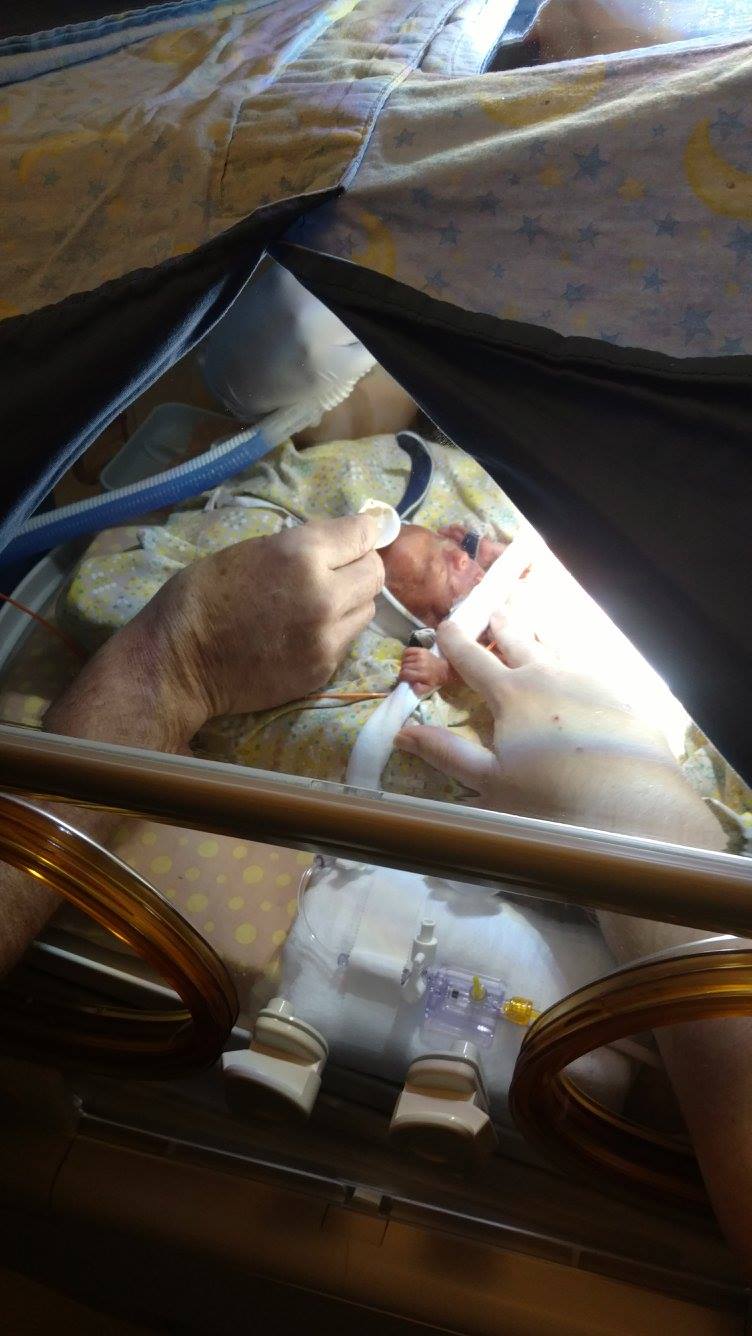
The smaller the baby, the more people needed for basic care.  Notice the arm waving free in spite of my husband and my best efforts.......

"Feisty" is good; Having a 2 pound baby who tries to lift his head and pull his ventilator tube out....not so good.  Hence the hand I have clamped on

Doing "containment" to help Jack feel secure.  He always likes having hands on his feet because he could kick at them.
Jack's around 3 weeks old or 29 weeks gestation in the picture.  He's on a ventilator still.  


Jack's first Christmas as Santa's newest elf.

Jack dressed as a vampire in honor of his fourth blood transfusion.


Jack's sharing some bonding time with my husband.


Jack's on NIPPV or CPAP in this pic.  He started regulating his body temp at a very young age so he'd overheat during skin-to-skin if we put a real blanket on him.  Hence the bandanna.
The most "Jackian" photo we have so far!  Dude does not like having his arms contained and will break free of any swaddle known to man...


Actually, this might be the most "Jackian".  Notice the hand shoved free of the swaddle and a leg held at a 45 degree angle.  When your kid is attached to monitors, you can use a weighted beanbag to make him feel safe....and keep his pacifier in place.

You really do get used to all the tubes and cords attached to your kid.  When I look at this picture, what I remember isn't the medical things but starting to cry when I came in Jack's nursery because Jack was in a real crib.
We dressed him for the first time at 35 weeks gestation (or 9 weeks after he was born).  It took me 20 minutes mainly because I'd never done a kimono style onesie before
When Jack was switched to a nasal cannula for oxygen, I felt like we had a changeling baby; I had gotten so used to the hat and mask for the NIPPV and CPAP that seeing his whole face and head was startling and wonderful.
Reading a book aloud on sustainability for my Master's.  The neonatologists were always telling us how good it was that we read to Jack; I've never had the heart to tell them that I read aloud because staring at a monitor while Jack was asleep was very, very boring.
Being able to pick up and hold my son without needing medical backup has been amazing!  Holding him when he was on a ventilator required at least 1 respiratory therapist and two nurses to safely transfer him to and from the isolette.  When he switched to NIPPV/CPAP, we only needed one nurse.  Now, I can pick him up whenever we want to or whenever he needs some cuddles.
Jack's Mafia enforcer face  :-)
"No, really, Dad.  The nurses said I can stay up all night.  Don't you believe me?"  I think we'll be seeing that face a lot :-P


Jack's sleeping in his dinosaur position in his dino jammies!