Sorry I'm running a bit late this week. The baby is working on erupting two or three top incisors, the wild swings in temperature/pressure are wreaking havoc with my migraines and I keep breaking out in eczema patches. Plus, it's January so the wonderful break I had for nearly of month of no doctor's visits for the baby is over.
I've been upfront about the fact that I am a traditionally schooled pre K - 12 graduate who jumped into a traditional college and then went back to the trenches of 9-12 education as a teacher. From that perspective, I'm going to lay out why parent-teachers need to figure out a way to give coherent and comprehensive grades to their students by the end of elementary school at the latest.
I'm going to expound on two reasons that home-schooling parents opt-out of grading their kids for conscious or unconscious reasons. Grading is a tricky task that requires a lot of practice. Teachers have to create grading criteria - and that's not as simple as it seems. The easiest set-up I can think of would be a text-book based system like the Maxwell Family uses. Even there, the parent-teacher has to make some choices. Do the classwork assignments count toward the final grade? How about quizzes? Are different categories of assignments weighted differently? Grading independent study or project-based learning courses is even harder. What does an "A" assignment look like in creative writing or paleontology or mandolin lessons compared to a "B" or a "C"?
The first issue can be overcome when parent-teachers learn how to pre-determine what each grade category looks like for each course. I don't have a good solution for the second issue because grading your own child accurately is so much harder than grading a random student. When I taught, I felt bad when a student failed my class - but I also had at least 80 other students who had passed that exact same class so student failures didn't feel like a personal reflection on my teaching. By comparison, when my son has a slight delay in his gross motor, fine motor or speech skills, I feel like I've failed somehow as a parent. The feeling passes quickly - but the feeling alone is an intense enough experience that I know that Jack's better off having an unrelated professional determine his "Ages and Stages" skill level. Even with my teaching experience, I would be tempted to justify passing him in skills - mainly by giving him points for other skills - to avoid feeling bad.
Why do we grade students? Grading students describes their performance against an age-appropriate standard, helps students learn how much procrastination they can get away with, and gives students practice with managing emotional responses to negative outcomes.
In a traditional school, students are surrounded by peers within a few years of age of them. Students generally get a feel for how they compare to their peers within each subject simply by comparing how much effort it takes and by seeing what grades other students get. When a student transferred into our school from another district, students were pretty accurate in their personal assessment of their skills in language arts, science, math and social studies. Students who transferred in from home schooling were a more mixed bag. Some students were very aware of which areas they had received little or no instruction in; other students believed that they were above average in a subject - but after testing and placement in a class it became clear that the student was working at markedly below grade level. Why is this important? Throughout life, people need to be able to assess their strengths and weaknesses compared to other people in their lives. As a teacher, I was middling-to-average at dealing with chronically angry students while above average in working with severely anxious students. When I had a chronically angry student, I would get support and tips from the teacher across the hall who was great with that student group - and I'd give her support and tips when dealing with anxious students.
Grading helps students learn time-management skills. For traditionally schooled students, the number of subjects they take in a day increases markedly from early elementary through junior high. As the number of classes scale upward, the students learn how to deal with conflicts like a project due the day after a math exam. Students learn the benefits of planning ahead and working at a pace that works for them. On the flip side, students learn about the drawbacks of finishing a paper at 2AM and being exhausted the next day. Chronic procrastination makes it much more difficult for students to earn "A" grades; few students can complete a high-school level project at the level of required difficulty if they don't start the project until the night before.
Finally, grading helps students learn how to manage the disappointment that comes from a poor grade - which I'll define as any grade lower than the one they wanted to get. That feeling of disappointment is intense and students learn how to release that emotion and continue moving towards a goal. After all, the vast majority of jobs involve periodic reviews by supervisors and some reviews include times where the supervisor gives the person a lower review than the person thought they were going to get. That sucks - but knowing how to manage negative feelings helps the person to move away from the feelings and into planning on how to improve their performance.
Showing posts with label homeschool science. Show all posts
Showing posts with label homeschool science. Show all posts
Sunday, January 14, 2018

Monday, January 8, 2018
Preparing Single Income Sons: Chapter Two
Chapter Two - "What is his earning potential?" - is where Steve walk adults who are home schooling children through the three characteristics that determine how much income a person will generate as an adult: vocation, education and skill level.
Frankly, I needed to pause and suspend my disbelief to finish the chapter. This is not a book marketed for children or pre-teens. This isn't a book for teenagers or even young adults. This book is marketed for adults who are actively home schooling one or more child. These people KNOW what leads to a well-paying job and what does not already.
The first characteristic that Steve leads off with is "vocation" - and his anecdotes give more insight into his mind than anything else.
When someone tells me their job, I don't immediately think about the person's financial status - but Steven Maxwell does. Truthfully, it's none of my damn business. Plus, there's such a huge range in amount of educational debt, personal debt, personal financial obligations and amount of salary that a lawyer might be struggling financially while a pastor is doing fine. My extended family has raised families of between 3-9 children on careers like nursing, fire fighting, teaching, social work, and engineering; it's more about planning and budgeting to use the money a household has.
Every family has that person who makes statements that sound deep - but the ideas are patently obvious to adults who can think for more than 10 seconds. Steve Maxwell is in that class:
So deep!
I planned to be a ballerina when I was in kindergarten. The fact that I couldn't put my heels down to the grounds due to severely tight calf muscles from cerebral palsy was (in my assessment) a benefit; I was already on my toes all the time.
What did I want to be next? I wanted to be a stay-at-home mom, a teacher, a naturalist, and a microbiologist. Oddly enough, I've worked as three out of the four of those (if I can count work in cellular biology as microbiology) and all four if I can count the hundreds of nature walks I took campers on as a "naturalist".
Yeah, we all have crazy career ideas - but listening to the career interests of kids can help parents and teachers figure out what a kid wants in a career. Key points for me turned out to be "likes providing education", "deals with science", and "has relatively high daily autonomy within a structured organization".
Let's take a look at how Steve handles a vocational interest of one of his sons:
An overarching theme in the Maxwell publications is that Steven Maxwell hates the idea of paying anyone else to educate his children - regardless of the outcome for the kids. Although he doesn't state this theme here, I doubt he was excited about the idea of Christopher paying around $2,500 for classes, textbooks and exams to become an EMT.
Maxwell does make important points about the drawbacks of working as an EMT. The shifts that a EMT works change drastically from week to week. Christopher would be exposed to a working partner who was not a member of the Maxwell Family; I know Steve dresses the situation up as a potential source of "temptation" - but Christopher's world might be more upended by a Christian male colleague who just talks with him on a regular basis about life.
The "temptation" factor hides another tricky point: I'm not certain that Christopher Maxwell could keep up in an EMS class. These classes are heavy on medical terminology and the Maxwell home school structure lacks advanced sciences like chemistry or human anatomy physiology. He'd be under a much heavier academic load than he'd ever been before - and some people can't do it.
My last concern - and it's the least important one - is that EMTs do not make much money. This isn't the end of the world; some take second jobs while others get advanced training to facilitate career moves from low-paying entry level jobs with private ambulance services to being employed by government entities or through hospital systems. For the Maxwell Family, all of these options would be considered second-rate and a rejection of the ideal of owning a home-based business.
I included this last quote from the "vocation" section because I find the thesis hilarious
.
If a family has strong feelings against alcohol, x-rated movies, or abortion and lives their lives to make those beliefs clear, why would one of their kids all of a sudden declare that they want to be a strip-club owner? Steven Maxwell is categorically against movies, television, the vast majority of books, professional sports, participating in team sports, most precious jewelry and recreational vehicles. How likely is it that one of his kids would seriously declare that they wanted to be an actor, a bookstore owner, or a scheduling manager for a local stadium? I grew up in a family that was highly involved in the pro-life movement; none of my siblings or cousins ever spontaneously opined that they really, really wanted to do abortions when they grew up.
The Bible isn't a great career study book. It's solid enough for things like moral precepts - but your kid should be pretty clear on moral job choices LONG before their teenage years.
Steven's second characteristic for income is education. The gist of the section is that only parents or students can be trusted to educate themselves. Outside educational programs will lead students astray. It's not a new idea and it's not terribly interesting so I'm going to skip the main section and move into the bits where he jumps completely off the rails:
Oh, my goodness! The Steve in the first chapter who is an electrical engineer whose eldest son out earned him is the author? Who have thought it? There are SO many electrical engineers who home school their kids then write a book about it.
Whether an advanced degree is useful depends on the discipline that the person works in, the career path that are interested in, and the amount of experience the person has. Right now, the average income for an electrical engineer in Michigan with a bachelor's degree is around $55,000 while a master's degree job averages $79,000 a year. Generally, bachelor's degree science jobs have relatively little autonomy while master's degree jobs tend to expect more independent work. Master's degrees are also the lowest expected degree for people who want to do managerial level work.
I think Steve is trying to appeal to the anti-intellectual element of CP/QF life - but declaring that he's bad at math and science beggars belief. The starting mathematics course for a bachelor's degree in engineering is calculus 1 - and progresses through calculus 2, calculus 3 and differential equations. Steve may not be the best math guy of the engineers he graduated with - but he's easily in the top 2-3% of all Americans.
On a purely picky note - I've never heard a radio ad that promotes a Master's degree program in engineering. That's a horrible way to attract potential candidates.
Steven is completely and totally backwards on how education affects the availability of jobs.
My first job was as a utility worker at a grocery store. This job was open to any person who was at least 16 years old and could legally work in the United States which means that about 73% of the US population could apply for that job. Locally, it was in an area where many people didn't go to college so roughly 80% of locals could apply for that job.
When I graduated from college with a bachelor's degree, I could still apply and get the utility worker job - and I could also apply for jobs that require bachelor's degrees like a laboratory technician and a variety of teaching jobs. Additional education credentials adds more jobs to a person's options. The specific job of "high school teacher with a BA or BC certification" was much less frequent - but there were very few people who could apply for the job and even fewer who actually applied. At the school I taught at, we were lucky to attract 20 applicants of which roughly 3-6 were interviewed.
Even his argument that the number of jobs that require a college degree are fewer is specious in certain locations. In the county I grew up in, there are many, many more teaching jobs than there were utility worker jobs; school systems were the largest employer and "teacher" is the most common job within a school system while the number of jobs that are available to people with a high school diploma as their highest completed schooling is tiny.
People do need to be careful about how much money they take out in loans while attending college. A good rule of thumb is that college students shouldn't take out more than they expect to earn during their first year out of college. On the flip side, college graduates on average out-earn people without college degrees throughout their career - a basic fact that Steve ignores.
The last category is personal skill level. That's a no-brainer - and thankfully, Steve restricts himself to a quick attack on a doctor he didn't like two decades ago:
Psst! Let me give you a hint: the doctor had been practicing successfully for 25-30 years! Let's assume that he was making enough money to get by.
Honestly, I have far more questions about the Maxwell parents' choices at this point.
Frankly, I needed to pause and suspend my disbelief to finish the chapter. This is not a book marketed for children or pre-teens. This isn't a book for teenagers or even young adults. This book is marketed for adults who are actively home schooling one or more child. These people KNOW what leads to a well-paying job and what does not already.
The first characteristic that Steve leads off with is "vocation" - and his anecdotes give more insight into his mind than anything else.
A man's vocation is generally what we think determines how much money he makes. If you meet a visitor at church and find out he is a doctor or a lawyer, you will likely think, "Here is someone with few financial difficulties." On the other hand, when we think of firemen, pastors, policemen, and school teachers, we don't picture them making huge salaries. (pg. 21)
When someone tells me their job, I don't immediately think about the person's financial status - but Steven Maxwell does. Truthfully, it's none of my damn business. Plus, there's such a huge range in amount of educational debt, personal debt, personal financial obligations and amount of salary that a lawyer might be struggling financially while a pastor is doing fine. My extended family has raised families of between 3-9 children on careers like nursing, fire fighting, teaching, social work, and engineering; it's more about planning and budgeting to use the money a household has.
Every family has that person who makes statements that sound deep - but the ideas are patently obvious to adults who can think for more than 10 seconds. Steve Maxwell is in that class:
It seems like every son wants to be a fireman, policeman, or bulldozer operator at some point in his young life. Then as he matures, other jobs catch his interest. Just because a person is interested in a profession doesn't mean it is right for him. (pg. 21)
So deep!
I planned to be a ballerina when I was in kindergarten. The fact that I couldn't put my heels down to the grounds due to severely tight calf muscles from cerebral palsy was (in my assessment) a benefit; I was already on my toes all the time.
What did I want to be next? I wanted to be a stay-at-home mom, a teacher, a naturalist, and a microbiologist. Oddly enough, I've worked as three out of the four of those (if I can count work in cellular biology as microbiology) and all four if I can count the hundreds of nature walks I took campers on as a "naturalist".
Yeah, we all have crazy career ideas - but listening to the career interests of kids can help parents and teachers figure out what a kid wants in a career. Key points for me turned out to be "likes providing education", "deals with science", and "has relatively high daily autonomy within a structured organization".
Let's take a look at how Steve handles a vocational interest of one of his sons:
Christopher, my second oldest son, was near the point of making a commitment to a vocation. He was very interested in pursuing EMT credentials to become an emergency medical technician. I wondered if his engrossment was mostly do to an excitement factor connected with EMT work. In addition, Christopher has a very strong leading toward raising a family someday. Christopher and I discussed and prayed about his vocation decision. We also discussed the fact that EMTs have to work odd shifts, and it is very common for a man and woman to be paired up. Having to work alone with a woman all day or night can lead to unhealthy temptation. The odd shifts also bring added difficulty to a family and would disrupt a daily schedule. Over time, Christopher could see the raising a family and being an EMT might bring problems to his marriage and family that would be prudent to avoid. ... I was pleased the Christopher saw the wisdom of pursuing a different career, even though it might be less exciting.
Please don't misunderstand me. Through my illustration, I am not saying a Christian can't have an EMT type job. I am saying that it is wise to count cost beforehand. (pg.22)
Please don't misunderstand me. Through my illustration, I am not saying a Christian can't have an EMT type job. I am saying that it is wise to count cost beforehand. (pg.22)
An overarching theme in the Maxwell publications is that Steven Maxwell hates the idea of paying anyone else to educate his children - regardless of the outcome for the kids. Although he doesn't state this theme here, I doubt he was excited about the idea of Christopher paying around $2,500 for classes, textbooks and exams to become an EMT.
Maxwell does make important points about the drawbacks of working as an EMT. The shifts that a EMT works change drastically from week to week. Christopher would be exposed to a working partner who was not a member of the Maxwell Family; I know Steve dresses the situation up as a potential source of "temptation" - but Christopher's world might be more upended by a Christian male colleague who just talks with him on a regular basis about life.
The "temptation" factor hides another tricky point: I'm not certain that Christopher Maxwell could keep up in an EMS class. These classes are heavy on medical terminology and the Maxwell home school structure lacks advanced sciences like chemistry or human anatomy physiology. He'd be under a much heavier academic load than he'd ever been before - and some people can't do it.
My last concern - and it's the least important one - is that EMTs do not make much money. This isn't the end of the world; some take second jobs while others get advanced training to facilitate career moves from low-paying entry level jobs with private ambulance services to being employed by government entities or through hospital systems. For the Maxwell Family, all of these options would be considered second-rate and a rejection of the ideal of owning a home-based business.
I included this last quote from the "vocation" section because I find the thesis hilarious
.
A child may also express interest in a career that Christians should not even consider such as owning a nightclub, movie rental store, abortion facility, or liquor store. It is possible his spiritual maturity is insufficient to realize something is wrong. That is where a parent can help him see God's will more clearly. Take him directly to Scripture to support your claims. The versus you use would make excellent Bible study topics for you and your son. (pg. 23)
If a family has strong feelings against alcohol, x-rated movies, or abortion and lives their lives to make those beliefs clear, why would one of their kids all of a sudden declare that they want to be a strip-club owner? Steven Maxwell is categorically against movies, television, the vast majority of books, professional sports, participating in team sports, most precious jewelry and recreational vehicles. How likely is it that one of his kids would seriously declare that they wanted to be an actor, a bookstore owner, or a scheduling manager for a local stadium? I grew up in a family that was highly involved in the pro-life movement; none of my siblings or cousins ever spontaneously opined that they really, really wanted to do abortions when they grew up.
The Bible isn't a great career study book. It's solid enough for things like moral precepts - but your kid should be pretty clear on moral job choices LONG before their teenage years.
Steven's second characteristic for income is education. The gist of the section is that only parents or students can be trusted to educate themselves. Outside educational programs will lead students astray. It's not a new idea and it's not terribly interesting so I'm going to skip the main section and move into the bits where he jumps completely off the rails:
Remember Steve, mentioned in Chapter One? That is me. If I had wanted a larger income, should I have pursued a master's degree? Yes, if I was to believe the commercials on the radio. However, that was not God's leading and not consistent with my abilities. Would I have made more money had I earned a master's? Only the Lord knows for sure, but with my limited math and science abilities, I doubt I would have justified the higher wages that a master's degree would have brought. As a result, I might have been discouraged, and the company employing me would not have felt they were getting their money's worth. (pg.24)
Oh, my goodness! The Steve in the first chapter who is an electrical engineer whose eldest son out earned him is the author? Who have thought it? There are SO many electrical engineers who home school their kids then write a book about it.
Whether an advanced degree is useful depends on the discipline that the person works in, the career path that are interested in, and the amount of experience the person has. Right now, the average income for an electrical engineer in Michigan with a bachelor's degree is around $55,000 while a master's degree job averages $79,000 a year. Generally, bachelor's degree science jobs have relatively little autonomy while master's degree jobs tend to expect more independent work. Master's degrees are also the lowest expected degree for people who want to do managerial level work.
I think Steve is trying to appeal to the anti-intellectual element of CP/QF life - but declaring that he's bad at math and science beggars belief. The starting mathematics course for a bachelor's degree in engineering is calculus 1 - and progresses through calculus 2, calculus 3 and differential equations. Steve may not be the best math guy of the engineers he graduated with - but he's easily in the top 2-3% of all Americans.
On a purely picky note - I've never heard a radio ad that promotes a Master's degree program in engineering. That's a horrible way to attract potential candidates.
Something else to consider is that those with higher degrees may experience difficulty in finding jobs. The workforce is like a pyramid and that the higher you climb the education ladder, the fewer jobs you'll find requiring those skills. That is why it is imperative that parents know God's direction for their child. Overconfidence may lead to disappointment when a degree does not bring the anticipated salary. In fact, I have heard people calling Christian radio talk shows complaining about how difficult it is to repay their student loan based on the amount of money they are currently making. They had expected a higher salary upon graduating with a degree. (pg. 24)
Steven is completely and totally backwards on how education affects the availability of jobs.
My first job was as a utility worker at a grocery store. This job was open to any person who was at least 16 years old and could legally work in the United States which means that about 73% of the US population could apply for that job. Locally, it was in an area where many people didn't go to college so roughly 80% of locals could apply for that job.
When I graduated from college with a bachelor's degree, I could still apply and get the utility worker job - and I could also apply for jobs that require bachelor's degrees like a laboratory technician and a variety of teaching jobs. Additional education credentials adds more jobs to a person's options. The specific job of "high school teacher with a BA or BC certification" was much less frequent - but there were very few people who could apply for the job and even fewer who actually applied. At the school I taught at, we were lucky to attract 20 applicants of which roughly 3-6 were interviewed.
Even his argument that the number of jobs that require a college degree are fewer is specious in certain locations. In the county I grew up in, there are many, many more teaching jobs than there were utility worker jobs; school systems were the largest employer and "teacher" is the most common job within a school system while the number of jobs that are available to people with a high school diploma as their highest completed schooling is tiny.
People do need to be careful about how much money they take out in loans while attending college. A good rule of thumb is that college students shouldn't take out more than they expect to earn during their first year out of college. On the flip side, college graduates on average out-earn people without college degrees throughout their career - a basic fact that Steve ignores.
The last category is personal skill level. That's a no-brainer - and thankfully, Steve restricts himself to a quick attack on a doctor he didn't like two decades ago:
When Joseph was a toddler, he developed a cough that wouldn't go away. We had just moved to Kansas, so we took him to a doctor we picked out of the telephone book. The physician was in his sixties and very personable. However, he had great difficulty looking in Joseph's throat as Joseph was not being very cooperative. After several attempts, he appeared to give up but said he'd seen enough to give us a prescription. Teri and I were confident he had not been successful in seeing Joseph's throat, and we felt he was guessing at a diagnosis. After a couple weeks with no improvement, we took Joseph to another doctor who promptly diagnosed and successfully treated him. Later we spoke with others who had tried the first doctor, and they too had opted for someone else.
Here was a doctor, with plenty of credentials and schooling, who should have been making a good salary. However, his skill level was poor. I don't know what his actual income might have been, but if the condition of his office and the lack of patients was any indication, the man was not making much money at all. (pg. 25)
Here was a doctor, with plenty of credentials and schooling, who should have been making a good salary. However, his skill level was poor. I don't know what his actual income might have been, but if the condition of his office and the lack of patients was any indication, the man was not making much money at all. (pg. 25)
Psst! Let me give you a hint: the doctor had been practicing successfully for 25-30 years! Let's assume that he was making enough money to get by.
Honestly, I have far more questions about the Maxwell parents' choices at this point.
- Steve had a job that presumably had coworkers. Joseph's cough had reached a chronic point so surely making the appointment could wait 24 hours for Steve to ask someone who lived in the area for a recommendation for a pediatrician or family practitioner.
- It's not like the doctor needed to do a detailed throat inspection; he was looking to see if the kid had post-nasal drip. All he needed was to see the throat for just long enough to see if it was reddened.
- Did the Maxwell parents fill the prescription? The story is not clear about that point.....
- Every drug I've ever taken for a cough says that if the cough doesn't improve in between 3-7 days to call the doctor for a follow-up. I feel terrible for poor toddler Joseph who has been hacking for around a month by the time his parents decided to find another doctor.
The next chapter is about a person's "real" earning potential. I can't wait!
Friday, January 5, 2018
Homeschooling Badly: Grade levels? We don't DO that!
I stumbled across a home schooling blog called the Hmmmschooling Mom that I really enjoy. Amy's posts show the type of level-headed thinking skills that benefit teachers of all stripes.
The first post I read dealt with why homeschooling parents should know what grade level their kids would be in if they were still in public schools - and why they need to stop acting aggrieved when anyone asks. Amy argues that grade level is a simple method of grouping children by age and ability level - and not a sideways attack on home schooling methodology.
I agree with that. It's also a safe question to ask kids who you have just met that allows for a short conversation about what they are doing at school.
Taking her idea one step farther, home schooling parents need to know at roughly what grade level each of their kids are working at in math, language arts, speech and social skills for pre-K through 2nd grade, for math, language arts, science, and social studies for 3rd-8th grade, and for math, language arts, science, social studies, physical education and foreign language in 9th-12th.
Before someone tells me about how they don't measure their kid's progress against artificially contrived benchmarks again, let me explain the two major reasons these pieces of information is important.
First - this information makes moving back into the traditional education system much more simple for the student. Hopefully, the student will be returning to traditional education as an adult in the collegiate system where having a detailed, accurate transcript will saves the student a great deal of time and money. I've also had more than one student who returned to a public high school with no educational records from their homeschooling period because of their home schooling parent died, suffered a major disability or separated from the family. When a student is dealing with a major stress event at home, having to test into or out of classes is a crap-shoot.
Second - parents who have taken over the academic education of their students are morally obligated to assess when their kids need more support. A kid who is working within the range of one year behind to two years ahead of their grade level most likely doesn't need outside support. (Another way to think of this is that in the average 2nd grade class room most kids will be reading at 1st, 2nd or 3rd grade levels - and the teacher can probably deal with a 4th grade reading level easily. Or that I often had 9th graders who could read at 12th-college levels - but I only had two kids who had maxed out the lexile levels at post-graduate.) Students who are far behind - or far advanced - bring a different set of challenges that tax experienced teachers. How do you find books that cover reasonably age-appropriate themes without being at the wrong reading level? How do you teach a kid to read who is dyslexic or math to a kid with discalculia?
Parents can be lead astray by assuming since a student is "researching" a higher level subject that they are learning the material at a higher grade level than they actually are. I was volunteering at an agricultural demonstration when a parent overheard that I had taught high school chemistry in the past. She introduced her fourth grade public schooled son - who was in no way interested in talking to me - and shared with pride that he loved chemistry and was learning really advanced material on his own like hydrogen bonding. I asked the kid to tell me about hydrogen bonds and he gave me a partially accurate definition of hydrogen bonding being when hydrogen and oxygen atoms are attracted to each other. I asked if hydrogen bonding only happens with hydrogen and oxygen. He said yes. I smiled and said something like "Ok." I asked what causes hydrogen bonds. He shrugged and started digging in the dirt. I gave him some recommendations for finding a worm (which was his goal) and dug with him for a few minutes. When he had warmed up a bit, I asked him what his favorite part of an atom was. He looked massively confused and said "Atoms have parts?". Meanwhile, his mom had been telling me in great detail how the two of them had watched videos on YouTube that showed how hydrogen bonds formed in water. I asked her if she knew how that benefited life on earth - and she looked at me if I grew another head.
Part of teaching high school chemistry is knowing what material a student should be aware of on a topic. The high school level answers to the questions I asked the kid included:
Every state has a series of standards and benchmarks available for K-12 education in (at least) math, science, social studies and language arts - and many have additional ones for foreign languages, physical education, health, and arts. Start when your kid is young; the standards are cumulative and the earliest grades tend to have very concrete standards that are pretty easy to understand. As students grow, the standards get more complicated - but a parent-teacher is only adding one new level per year; that gives them a full year to decipher what next year's courses need to have.
My next post in this theme will be on the home school boogeyman - grading students!
The first post I read dealt with why homeschooling parents should know what grade level their kids would be in if they were still in public schools - and why they need to stop acting aggrieved when anyone asks. Amy argues that grade level is a simple method of grouping children by age and ability level - and not a sideways attack on home schooling methodology.
I agree with that. It's also a safe question to ask kids who you have just met that allows for a short conversation about what they are doing at school.
Taking her idea one step farther, home schooling parents need to know at roughly what grade level each of their kids are working at in math, language arts, speech and social skills for pre-K through 2nd grade, for math, language arts, science, and social studies for 3rd-8th grade, and for math, language arts, science, social studies, physical education and foreign language in 9th-12th.
Before someone tells me about how they don't measure their kid's progress against artificially contrived benchmarks again, let me explain the two major reasons these pieces of information is important.
First - this information makes moving back into the traditional education system much more simple for the student. Hopefully, the student will be returning to traditional education as an adult in the collegiate system where having a detailed, accurate transcript will saves the student a great deal of time and money. I've also had more than one student who returned to a public high school with no educational records from their homeschooling period because of their home schooling parent died, suffered a major disability or separated from the family. When a student is dealing with a major stress event at home, having to test into or out of classes is a crap-shoot.
Second - parents who have taken over the academic education of their students are morally obligated to assess when their kids need more support. A kid who is working within the range of one year behind to two years ahead of their grade level most likely doesn't need outside support. (Another way to think of this is that in the average 2nd grade class room most kids will be reading at 1st, 2nd or 3rd grade levels - and the teacher can probably deal with a 4th grade reading level easily. Or that I often had 9th graders who could read at 12th-college levels - but I only had two kids who had maxed out the lexile levels at post-graduate.) Students who are far behind - or far advanced - bring a different set of challenges that tax experienced teachers. How do you find books that cover reasonably age-appropriate themes without being at the wrong reading level? How do you teach a kid to read who is dyslexic or math to a kid with discalculia?
Parents can be lead astray by assuming since a student is "researching" a higher level subject that they are learning the material at a higher grade level than they actually are. I was volunteering at an agricultural demonstration when a parent overheard that I had taught high school chemistry in the past. She introduced her fourth grade public schooled son - who was in no way interested in talking to me - and shared with pride that he loved chemistry and was learning really advanced material on his own like hydrogen bonding. I asked the kid to tell me about hydrogen bonds and he gave me a partially accurate definition of hydrogen bonding being when hydrogen and oxygen atoms are attracted to each other. I asked if hydrogen bonding only happens with hydrogen and oxygen. He said yes. I smiled and said something like "Ok." I asked what causes hydrogen bonds. He shrugged and started digging in the dirt. I gave him some recommendations for finding a worm (which was his goal) and dug with him for a few minutes. When he had warmed up a bit, I asked him what his favorite part of an atom was. He looked massively confused and said "Atoms have parts?". Meanwhile, his mom had been telling me in great detail how the two of them had watched videos on YouTube that showed how hydrogen bonds formed in water. I asked her if she knew how that benefited life on earth - and she looked at me if I grew another head.
Part of teaching high school chemistry is knowing what material a student should be aware of on a topic. The high school level answers to the questions I asked the kid included:
- Hydrogen bonds occur between molecules that have strongly polar covalent bonds. Hydrogen and oxygen are common examples - but many of the elements in the same family as oxygen will form hydrogen bonds.
- Hydrogen bonds occur because some atoms share electrons unequally in bonds. This unequal sharing causes the atom that holds on to the electron longer to act like it has a slight negative charge and the atom that get the electron less to have a slight negative charge. A hydrogen bond occurs when two molecules are attracted to each other because the slightly negative atom aligns with the slightly positive atom.
- Life on Earth has benefited from hydrogen bonds because hydrogen bonds cause water to freeze into a less dense solid form. IOW, hydrogen bonds are the reason that ice floats on water; most chemicals have solids that sink to the bottom of the liquid while freezing. Since ice floats, it acts as an insulator so that bodies of water take much, much longer to freeze solid that an equivalent size body of liquid without hydrogen bonds. This gives aquatic organisms the ability to survive in the liquid portions of ponds, rivers, lakes and oceans during the winter.
Every state has a series of standards and benchmarks available for K-12 education in (at least) math, science, social studies and language arts - and many have additional ones for foreign languages, physical education, health, and arts. Start when your kid is young; the standards are cumulative and the earliest grades tend to have very concrete standards that are pretty easy to understand. As students grow, the standards get more complicated - but a parent-teacher is only adding one new level per year; that gives them a full year to decipher what next year's courses need to have.
My next post in this theme will be on the home school boogeyman - grading students!
Monday, December 25, 2017
ATI Wisdom Booklet: STD's, Cervical Cancer and Infant Vitamin K levels
These Wisdom Booklets are full of shoddy facts - but thankfully, most of them will not kill people. People can and do live fulfilling lives in spite of knowing nothing about evolution or the Second Law of Thermodynamics.
Unfortunately, the same Wisdom Booklet that contains the Evils of Evolution also has a medical section that makes some outlandish, mistaken and potentially lethal claims about sexually transmitted diseases, cervical cancers and infant production of Vitamin K after birth.
The section covers random Old Testament Laws that pertain cleanliness and purity and attempts to prove that there's a valid medical reason for each of them. The writer manages to stretch the list into seven items by covering the idea that blood can transmit diseases in three separate items, implying that cud-chewing ruminants have less parasites and diseases than other animals in two separate items, applying bio-amplification in food chains to the animals that are forbidden in the Bible, and stating that eating fat leads directly to heart disease.
Unfortunately, most of those are simply wrong.


Merry Christmas!
Unfortunately, the same Wisdom Booklet that contains the Evils of Evolution also has a medical section that makes some outlandish, mistaken and potentially lethal claims about sexually transmitted diseases, cervical cancers and infant production of Vitamin K after birth.
The section covers random Old Testament Laws that pertain cleanliness and purity and attempts to prove that there's a valid medical reason for each of them. The writer manages to stretch the list into seven items by covering the idea that blood can transmit diseases in three separate items, implying that cud-chewing ruminants have less parasites and diseases than other animals in two separate items, applying bio-amplification in food chains to the animals that are forbidden in the Bible, and stating that eating fat leads directly to heart disease.
Unfortunately, most of those are simply wrong.
- Blood can transmit diseases - but it's a poor vector compared to oral-fecal and airborne routes.
- Pigs that free-range and have access to carrion are at much higher risk of parasitic diseases than grass-eating ruminants - but that's because the pig is an omnivorous trash can. Kept reasonably contained and fed pig food, table scraps, waste milk, forage crops etc., and you get a parasite free piggy.
- The Bible forbids some animals that do bio-amplification like mussels - but left in cows. In the US, the most dangerous food for bio-amplification for generations was milk or meat after cows ate milk snake-root. (Oops.)
- The fat = heart disease theory was in vogue when the Wisdom Booklet was written - but it's not particularly accurate. Heart disease has many causes and many interlocking parts.
Eight and nine, though, are just plain dangerous.

Let me give a quick rundown of the real history of the discovery of the connection between human papillomavirus (HPV) and cervical cancer. First, doctors studying cervical cancer had noticed a strange phenomenon. Women who had never had sex had extremely low rates of cervical cancer - way lower than rates of women who had had sexual intercourse. One example - although not the only - were groups of monastic nuns who volunteered their bodies to science. Their rates of cervical cancer were non-existent.
On the other hand, the rate of sexual partners to rate of cervical cancer wasn't directly correlated - no matter what the ATI booklet wants to imply - for reasons that are pretty obvious once the HPV connection was made. Some women have a single sexual partner who gave them HPV. Other women have multiple partners but never contracted HPV. Some women who have HPV develop cervical cancer while others do not.
The discovery of HPV and cervical cancer was found after this booklet was published - but women had a perfectly good screening method for cervical cancer known as a Pap smear. In fact, women still receive Pap smears after testing negative for HPV every 3-5 years to catch non-HPV cervical cancers early enough for non-invasive treatment. Nowadays, we have the HPV vaccine for teens which greatly reduces their risk of cervical, penile, oral and neck cancer which is a great advancement.
Women can be allergic to their husband's semen. That's a real phenomenon - but women KNOW when it happens. Vaginal skin develops the same reaction that all skin does after an allergic reaction - red, itchy, burning irritated skin. It's pretty rare - and has no relation to cervical cancer.

Nothing like a creepy clip-art to bring home the point.

Um...kind of.
Look, I'm old enough to realize that just because one spouse is monogamous doesn't mean that their spouse is. Good behavior doesn't protect innocent people from other people's bad behavior.
Look, I'm old enough to realize that just because one spouse is monogamous doesn't mean that their spouse is. Good behavior doesn't protect innocent people from other people's bad behavior.
Condoms work quite well to prevent STDs as well.
HIV is transmitted through sexual activity - but it can also be transmitted by intravenous drug use, accidental needle sticks or from blood transfusions prior to modern donor screening.
HIV is transmitted through sexual activity - but it can also be transmitted by intravenous drug use, accidental needle sticks or from blood transfusions prior to modern donor screening.

In fairness to the inhabitants of Canaan, their main sin was worshiping other gods. I think that the last sentence is supporting the anti-circumcision argument that an intact foreskin has more sensitivity - but the sentence unclear. The most current AAP recommendation on infant circumcision is that parents should make decisions based on their cultural, religious and social beliefs.

Again, there's a weird mix of truth and lies mixed together.
Yes, uncircumcised men have to clean under the foreskin. The foreskin doesn't retract immediately in young boys so that's not an large problem before the kid is old enough to learn how to clean his penis. On the other hand, some circumcised boys have a foreskin remnant that needs to be cleaned under until the penis grows enough that it is permanently retracted. Either way, we are not taking about a major difference in personal hygiene.
Uncircumcised men do have slightly higher rates of STDs including HIV - but the difference can be eliminated by the use of condoms in non-monogamous relationships. Uncircumcised men have higher rates of cancer of the penis - but that's a super-rare cancer.
Oh - this next one might kill a kid pointlessly.


Human infants are born with very low Vitamin K levels. Vitamin K doesn't cross the placenta well. The bacteria that produce Vitamin K in the digestive tract don't produce large amounts of Vitamin K until solid foods are introduced at between 4-6 months.
The real danger of low Vitamin K levels in infants isn't due to visible surface cuts. First, the body has an entirely different clotting cascade that happens when skin is cut. Second, parents are surprisingly good at connecting "My baby is covered in blood" with the response of "Get medical help immediately!". No, the real danger is bleeding into the brain or intestines. That can lead to a very, very ill baby before parents realize the problem.
The real danger of low Vitamin K levels in infants isn't due to visible surface cuts. First, the body has an entirely different clotting cascade that happens when skin is cut. Second, parents are surprisingly good at connecting "My baby is covered in blood" with the response of "Get medical help immediately!". No, the real danger is bleeding into the brain or intestines. That can lead to a very, very ill baby before parents realize the problem.
There's a mindlessly easy solution: newborns are given a large injected dose of Vitamin K after birth - assuming their parents do not withhold consent due to mistaken beliefs in the power of cuddling.

Argh. The mix of truth and lies gets under my skin.
True: Vitamin K is fat-soluble; that's why doctors can give newborns a shot of Vitamin K that lasts for 6 months. Fat-soluble vitamins do need fat to be absorbed by the body.
Lies: Human breast-milk has very low levels of Vitamin K regardless of the fat content. Assuming your child is a healthy, term baby, no one is going to interfere with breastfeeding let alone insist on antiseptic contact. (Heck, even with my micro-preemie son, we were encouraged to clean under our nails, wash to the elbow for 30 seconds and use hand sanitizer at his bedside. It's more than need for a term baby - but hardly over the top.)
No one's against circumcision on the 8th day after a son is born - but get the Vitamin K shot first.True: Vitamin K is fat-soluble; that's why doctors can give newborns a shot of Vitamin K that lasts for 6 months. Fat-soluble vitamins do need fat to be absorbed by the body.
Lies: Human breast-milk has very low levels of Vitamin K regardless of the fat content. Assuming your child is a healthy, term baby, no one is going to interfere with breastfeeding let alone insist on antiseptic contact. (Heck, even with my micro-preemie son, we were encouraged to clean under our nails, wash to the elbow for 30 seconds and use hand sanitizer at his bedside. It's more than need for a term baby - but hardly over the top.)
Merry Christmas!
Friday, December 15, 2017
ATI Wisdom Booklet: The Evils of Evolution - Part Three
Welcome to the last post on the Evils of Evolution according to ATI's Wisdom Booklet! Now, the booklet starts with a several page discussion of the first two laws of thermodynamics before attempting to explain why evolution breaks those laws.


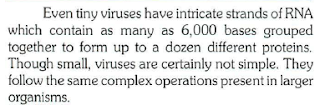


The first section is filled with "facts" that are badly mistaken. Evolution is not directional; there is no reason to expect that organisms will always become more complicated or will never become less complex. Organisms can lose organs that are not useful in their environment.
- Whales have vestiges of hind legs that have become greatly reduced down to bone spurs.
- Many organisms that live in caves or in the deep ocean lack eyes.
- One hypothesis about the evolution of viruses is that viruses evolved from a common ancestor to bacteria into a parasite that requires other organisms to reproduce.
I am uncertain about what the clause "and also experience" means in the last sentence.

The Second Law of Thermodynamics does state that entropy (or disorder) increases in a random flow of energy.
The reason the Second Law of Thermodynamics doesn't apply to living organisms is that living organisms capture energy from the environment and use that energy to repair the disorder that occurs. For example, being a warm-blooded organism brings a higher rate of mutations in DNA simply because the nucleotides that make up DNA and RNA are more unstable at higher temperature. This is offset by the energy liberated from food that is used to repair DNA.
When does the Second Law of Thermodynamics apply to living things? It applies when they die; they stop taking in energy and at that point the body disintegrates.
Mutations are random - and can create more complicated organisms. As I mentioned in the last post, mutations are generally silent, occasionally negative, and rarely positive.
Labeling mutations as a destructive force that increases entropy is just plain weird. A mutation is not necessarily a lower state of entropy compared to the original state; a mutation is often part of a very complex chemical structure and can create complicated chemical structures - in other words - a mutation can lower entropy. The comparison to an earthquake is purposefully misleading - but hey, it's ATI......


The world is a fascinating place - and it's fascinating enough that ATI's authors didn't need to fudge the truth.
Yes, bacteria have pretty cool cell walls - but it's not like each bacterial species has a completely unique type of cell wall. The cell walls are similar enough between two large sub-group of bacteria that microbiologists use the type of cell wall as the first step in determining the identity of a bacteria. The Gram stain to identify the cell wall uses a two-step staining technique on a slide with bacteria on it. The two groups are referred to as "Gram negative" and "Gram positive". Added bonus: a lot of antibiotics work by breaking holes in the cell wall and cellular membrane of a bacteria so knowing that an infection is by a Gram negative (or positive) gives doctors a quick way to eliminate certain classes of antibiotics when a patient is suffering an infection.
Viruses DO NOT do the same complex operations that larger organisms do. There's always a debate about if viruses are alive or not. The issue is that viruses cannot reproduce on their own; they do not have the cellular equipment to do that any more. A virus has to invade a cell, hijack the DNA or RNA of the cell, and use the cellular equipment to produce more viruses. I fall in the "viruses are not alive" category of scientists.
I'm very curious how ATI would deal with prions.....

That's right enough. It's a bit outdated because "geographic separation" is not a requirement of speciation - especially in non-animal organisms. Plants are known for producing a genetically abnormal offspring that cannot breed back to the parent species because of a mismatch between chromosome number. In animals, that would mean the organism couldn't reproduce. Plants, though, have a trick up their (proverbial) sleeves; they can reproduce asexually. If that abnormal plant sends off a runner that grows into a new plant, that new plant has the name number of chromosomes as the abnormal plant. Now, the abnormal plant and its clone can reproduce sexually using flowers again. Poof! We've now had a new species evolve in the middle of an existing species without geographic separation.
The author then goes into great detail about how the frequency of the morphs in the British pepper moth changed from "mostly light" before the Industrial Revolution to "mostly dark" during the Industrial Revolution back to "mostly light" as pollution decreased.
The author then goes into great detail about how the frequency of the morphs in the British pepper moth changed from "mostly light" before the Industrial Revolution to "mostly dark" during the Industrial Revolution back to "mostly light" as pollution decreased.

I kept waiting for the author to explain why they were harping on about pepper moth morphs and lab coat color and how it disproves evolution. See, species are usually defined as organisms who can interbreed and produce fertile offspring. Light and dark pepper moths are both members of one species of moth. Ditto for different coat colors in dogs.
There's a separate issue involving dogs and horses. Humans try to keep purebred lines of dogs and horses for around 200 years- and the dogs and horses work as diligently to cross-breed with whatever member of their species comes near them. It's a bit easier with horses now since relatively few stallions are kept by private owners compared to mares and geldings - but an intact dog will travel (or cause intact males to travel) long distances to find females in heat. Heck, we had a group of steers (which are castrated male cattle) get out, wander to another dairy farm 5 miles away and start to hang out around the cows who were in heat. Livestock aren't picky - and they know far more about how to find a mate than humans give them credit for.
The last section is the most flaky argument - both scientifically and theologically.


The only way ATI can try and make homologous structures in organisms seem scientifically invalid is by doing a botched job on the history section. Sure, scientists compared the skeletal structure of different animals in the 1500's. Next, they looked at the cellular structure of tissues beginning in the early 1600s. By 1800, scientists were working out the relative ages of fossils and comparing the structures found in fossils to living organisms as well. Research exploded in the 1900s - scientists figured out how to look at cellular structure within fossils as well as developed ways to compare protein, RNA, and DNA sequences using various techniques.
The neat thing - all of these fields added new information that helped scientists tease out which organisms were related to each other. It's not like scientists are relying solely on anatomical drawings from the 1500s alone.
And this is where ATI goes off the rails theologically.
The neat thing - all of these fields added new information that helped scientists tease out which organisms were related to each other. It's not like scientists are relying solely on anatomical drawings from the 1500s alone.
And this is where ATI goes off the rails theologically.
Yup. ATI falls back into the common CP/QF heresy that God's omnipotence is constrained within the physical world. God's just like a human painter - artists are constrained within style, techniques and design. God is constrained so that most bacteria only have two cell wall types, entire gene sequences are conserved between species, and lots of animals have similar skeletons.
To me, the most obvious response is that if an omnipotent Creator could make anything - anything! - and didn't want to create evolution, why don't we have more variation? Like a vertebrate with six legs or hairy fish? Really, an evolved world is much more boring than the creations possible by a Divine Creator.
To me, the most obvious response is that if an omnipotent Creator could make anything - anything! - and didn't want to create evolution, why don't we have more variation? Like a vertebrate with six legs or hairy fish? Really, an evolved world is much more boring than the creations possible by a Divine Creator.

I love this trick! ATI makes a deep sounding statement about bones and skin - then stops dead. Ending is important because giving any sort of detail about how bones or skins are 'irreconcilably' different will be disproved rapidly and easily by comparative anatomists. Better to just stop and run away before anyone asks questions.
Boom! Done with evolution for now :-)
Boom! Done with evolution for now :-)
Wednesday, December 6, 2017
ATI Wisdom Booklets: The Evils of Evolution - Part Two
I know this is out of the normal weekly rotation - but my son was insanely cranky yesterday and skipped most of two naps because he was teething and had a bit of a stomach bug. (I dreamed of dropping him off at the zoo to be raised by lemurs until he's a bit older.) I can't bring myself to read "Maidens of Virtue" or any of the CP/QF books into my transcription software in front of him. As much as I know he's way too young to understand it, I just don't want him to hear this crap.
The Wisdom Booklet crap is equally harmful - but it's all screenshots so he doesn't hear anything while he's playing. And - thankfully - he's back to his usual self today except he's taking long naps.
In the first post, I gave a rough outline of what the theory of evolution states. This post will cover their third and fourth objections to evolution - which make me amazingly happy.

Most of the information in the first section is correct - if weirdly absent of terminology.
Mutations are changes in the DNA of a cell that is not caught by any of the cellular repair mechanisms AND causes a change in the amino acid that the DNA codes for. To oversimplify, DNA is used to make RNA. RNA is used to make a string of amino acids. Those amino acid strings become building materials, hormones and all sorts of really important things in cells.
Here's the mind-blowing factoid that ATI's authors missed: most mutations are silent or benign. The whole DNA-->RNA--> amino acid process works in chunks of three chemicals. Of those three chemicals, the third place is the most likely to mutate due to some quirks in biochemistry. If you look at the chart below - stolen from Khan Academy - the translation between RNA and amino acids often is the same regardless of what the third letter is:

Obviously, it's not a perfect system. If an RNA strand that is supposed to be GAU = aspartic acid is translated as GAA = glutamic acid, that could be a serious problem - or the chemical switch could be silent if aspartic acid and glutamic acid act enough alike in the protein - or the new protein might work a bit better.
Oh, and we can't forget that for all non-sex chromosomes, people have two working copies. The most common outcome of a harmful mutation is that the new protein sucks - but the other non-mutated copy works well enough that the organism survives without major problems.
The basic rule of thumb I learned was that silent mutations were the most common followed by harmful mutations and finally a few mutations turn out to be helpful.


The first paragraph of this section is rather disjointed. All cells are under mutation pressure - but mutations are only passed on to the next generation if they occur in germ-line cells e.g., cells that become sperm and eggs. Those cells are under additional levels of protection like the fact that egg cells in girls' ovaries are kept in a non-dividing state from prior to birth until puberty. It's also posited that the reason so many mammals keep testicles in an external scrotum is to reduce the damage that body temperature does to DNA.
Next, the paragraph shifts into a glancing mention of an academic disagreement between different evolutionary scientists' beliefs of what time scale evolution happen on - known as "punctuated equilibrium" not punctuated evolution. (Thumps head softly) It's an arcane argument that theorists on both sides enjoy blasting each other about - but both sides agree that evolution happens. I'm certain that neither side would appreciate being used as a sign evolution was flawed......
The second paragraph is a hoot!

Ignore the double-speak about "exalts its own rights" - that's some ham-handed ATI speak for "ignore your own needs, peon!" Outside of that, the basic outline of natural selection is solid enough. I'd add, though, that the survivors need to survive AND reproduce for evolution to occur.


I don't want to go berserk on this - so replace the word "gene" with the word "allele" in that entire paragraph. All humans have two copies of the gene that produces hemoglobin. Each of those copies is called an allele. A person cannot be missing the entire gene for hemoglobin and survive past the first-trimester. People can have copies of the hemoglobin allele that produce slightly different types of hemoglobin. (People make this mistake ALL_THE_TIME and it drives me batty. 99% of the time that people say "gene" they mean "allele")
Hmmm. I wonder what caused the allele that causes sickle-cell anemia in people who have two copies of it......
Oh, wait. IT'S A MUTATION! A mutation caused a change that has a benefit! OMG!
Hmmm. Why would a mutated allele that causes severe pain and organ damage in offspring with two copies of that allele stay in the gene pool?
Oh, wait. IT'S EVOLUTION! IN PEOPLE!
The real story is so much more fascinating than ATI gives credit for.
In areas with endemic malaria, having one standard hemoglobin allele and one sickle-cell allele reduces the risk of contracting malaria greatly because half of the red blood cells in the body essentially collapse and entomb malaria parasites if infected. This group of people will survive to adulthood to reproduce. People with two standard hemoglobin alleles have a high risk of dying of malaria especially before age 5. People with two sickle-cell alleles are nearly immune to malaria - but untreated sickle-cell anemia generally kills people very young (and makes pregnancy very dangerous). This means that populations in areas where malaria is endemic are most stable with a fairly high number of people carrying one copy of the sickle-cell trait.
In areas where malaria is not endemic, the selection pressure changes. The reproductive advantage moves to people who have two standard copies since none of their children will die of sickle-cell anemia - even if they have children with someone who has a single-copy of the sickle-cell allele. The next best option is a single copy - but prior to genetic testing, this ran the risk of having babies with someone else who also carried the sickle-cell trait. For those couples, there is a 25% chance with each pregnancy that the baby will have sickle-cell anemia - and sickle-cell is no joke even with modern medicine.
This lead to a really cool study that looked at the changes in the frequency of the sickle-cell allele in people in Sub-Saharan Africa compared to African-Americans descended from slaves from Sub-Saharan Africa. Prior to ~1900, malaria was endemic in the Deep South so sickle-cell allele rates were assumed to have remained constant in African-American populations. In the early 1900's, the US underwent a massive public health campaign to control mosquitoes in hopes of eradicating yellow fever.
It worked - and wiped out malaria as a side-effect. When the pressure from malaria was removed, the frequency of the allele for sickle-cell anemia began to drop among African-Americans. Now, the frequency is much, much lower in African-Americans than it is in people from Sub-Saharan Africa.
One more post on evolution to come :-)
In the first post, I gave a rough outline of what the theory of evolution states. This post will cover their third and fourth objections to evolution - which make me amazingly happy.
Mutations are changes in the DNA of a cell that is not caught by any of the cellular repair mechanisms AND causes a change in the amino acid that the DNA codes for. To oversimplify, DNA is used to make RNA. RNA is used to make a string of amino acids. Those amino acid strings become building materials, hormones and all sorts of really important things in cells.
Here's the mind-blowing factoid that ATI's authors missed: most mutations are silent or benign. The whole DNA-->RNA--> amino acid process works in chunks of three chemicals. Of those three chemicals, the third place is the most likely to mutate due to some quirks in biochemistry. If you look at the chart below - stolen from Khan Academy - the translation between RNA and amino acids often is the same regardless of what the third letter is:

Obviously, it's not a perfect system. If an RNA strand that is supposed to be GAU = aspartic acid is translated as GAA = glutamic acid, that could be a serious problem - or the chemical switch could be silent if aspartic acid and glutamic acid act enough alike in the protein - or the new protein might work a bit better.
Oh, and we can't forget that for all non-sex chromosomes, people have two working copies. The most common outcome of a harmful mutation is that the new protein sucks - but the other non-mutated copy works well enough that the organism survives without major problems.
The basic rule of thumb I learned was that silent mutations were the most common followed by harmful mutations and finally a few mutations turn out to be helpful.


The first paragraph of this section is rather disjointed. All cells are under mutation pressure - but mutations are only passed on to the next generation if they occur in germ-line cells e.g., cells that become sperm and eggs. Those cells are under additional levels of protection like the fact that egg cells in girls' ovaries are kept in a non-dividing state from prior to birth until puberty. It's also posited that the reason so many mammals keep testicles in an external scrotum is to reduce the damage that body temperature does to DNA.
Next, the paragraph shifts into a glancing mention of an academic disagreement between different evolutionary scientists' beliefs of what time scale evolution happen on - known as "punctuated equilibrium" not punctuated evolution. (Thumps head softly) It's an arcane argument that theorists on both sides enjoy blasting each other about - but both sides agree that evolution happens. I'm certain that neither side would appreciate being used as a sign evolution was flawed......
The second paragraph is a hoot!
- The second law of thermodynamics is that within an isolated or closed system, transfers of energy lose a small amount of energy each time AND that disordered states are more stable than ordered states. The problem with attempting to shoe-horn the second law of thermodynamics into biology is that living organisms actively bring energy from outside their body system into the system. IOW, living organisms use energy to prevent their bodies from becoming disordered - and are NOT isolated or closed systems.
- The author implies that cells are completely helpless in the face of mutations - but that's not true at all! Cells have many mechanisms to prevent the loss of information from mutations. The ones I can remember from my college classes years ago include (but are not limited to)
- Having at least two copies of each gene to compare against each other for mistakes
- Cellular mechanisms to repair common issues like C-C dimers or replacement of missing nucleotide
- The redundancy within the genetic code discussed above
- The ability to destroy non-functioning proteins
- The ability to sacrifice a cell that is showing abnormal proteins in multi-cellular organisms
- There is one more "trick" - although it is a painful trick now that we can diagnose pregnancies very early. Catastrophic abnormalities are extremely common in human reproduction - that's why roughly 20% of known first-trimester pregnancies end in a miscarriage.
This next bit is where it gets so funny. The ATI position on mutations is "MUTATIONS ARE BAD, BAD, BAD!" Too bad the person who wrote the next section missed that memo.....

Ignore the double-speak about "exalts its own rights" - that's some ham-handed ATI speak for "ignore your own needs, peon!" Outside of that, the basic outline of natural selection is solid enough. I'd add, though, that the survivors need to survive AND reproduce for evolution to occur.


I don't want to go berserk on this - so replace the word "gene" with the word "allele" in that entire paragraph. All humans have two copies of the gene that produces hemoglobin. Each of those copies is called an allele. A person cannot be missing the entire gene for hemoglobin and survive past the first-trimester. People can have copies of the hemoglobin allele that produce slightly different types of hemoglobin. (People make this mistake ALL_THE_TIME and it drives me batty. 99% of the time that people say "gene" they mean "allele")
Hmmm. I wonder what caused the allele that causes sickle-cell anemia in people who have two copies of it......
Oh, wait. IT'S A MUTATION! A mutation caused a change that has a benefit! OMG!
Hmmm. Why would a mutated allele that causes severe pain and organ damage in offspring with two copies of that allele stay in the gene pool?
Oh, wait. IT'S EVOLUTION! IN PEOPLE!
The real story is so much more fascinating than ATI gives credit for.
In areas with endemic malaria, having one standard hemoglobin allele and one sickle-cell allele reduces the risk of contracting malaria greatly because half of the red blood cells in the body essentially collapse and entomb malaria parasites if infected. This group of people will survive to adulthood to reproduce. People with two standard hemoglobin alleles have a high risk of dying of malaria especially before age 5. People with two sickle-cell alleles are nearly immune to malaria - but untreated sickle-cell anemia generally kills people very young (and makes pregnancy very dangerous). This means that populations in areas where malaria is endemic are most stable with a fairly high number of people carrying one copy of the sickle-cell trait.
In areas where malaria is not endemic, the selection pressure changes. The reproductive advantage moves to people who have two standard copies since none of their children will die of sickle-cell anemia - even if they have children with someone who has a single-copy of the sickle-cell allele. The next best option is a single copy - but prior to genetic testing, this ran the risk of having babies with someone else who also carried the sickle-cell trait. For those couples, there is a 25% chance with each pregnancy that the baby will have sickle-cell anemia - and sickle-cell is no joke even with modern medicine.
This lead to a really cool study that looked at the changes in the frequency of the sickle-cell allele in people in Sub-Saharan Africa compared to African-Americans descended from slaves from Sub-Saharan Africa. Prior to ~1900, malaria was endemic in the Deep South so sickle-cell allele rates were assumed to have remained constant in African-American populations. In the early 1900's, the US underwent a massive public health campaign to control mosquitoes in hopes of eradicating yellow fever.
It worked - and wiped out malaria as a side-effect. When the pressure from malaria was removed, the frequency of the allele for sickle-cell anemia began to drop among African-Americans. Now, the frequency is much, much lower in African-Americans than it is in people from Sub-Saharan Africa.
One more post on evolution to come :-)
Friday, December 1, 2017
ATI Wisdom Booklets: The Evils of Evolution - Part One
Oh, boy! I've been waiting for this one! *rubs hands together gleefully*
I love evolution. That's not a strong enough statement. I adore evolution. *dances around the room*
ATI does not love or adore evolution. Like most evolution-haters, they have cobbled together a counter-argument based on misleading statements about the theory of evolution, mangling (or ignoring) basic facts, and a deep hope that no one asks them any follow up questions.
In science, the term "theory" means an over-arching process that explains many different phenomena. Evolution is a theory because it explains why:
- Humans and chimpanzees have similar DNA
- Antibiotic resistance spreads between bacteria
- The frequency of the gene that causes sickle-cell anemia is different in African-Americans than populations in Western Africa
- Pepper moth coloration has shifted from whitish to grey to whitish within 200 years
- Human babies generally weigh between 5-9 pounds at birth
- A million other facts in biology
The term "theory" does not mean unproven, experimental or controversial.
Evolution will never become a law because the term "law" describes a single process. For example, the ideal gas law describes how temperature, pressure and volume in a gas interact.
The basic idea of evolution is very straight forward.

Evolution will never become a law because the term "law" describes a single process. For example, the ideal gas law describes how temperature, pressure and volume in a gas interact.
The basic idea of evolution is very straight forward.
- Genes comes in different forms that are known as alleles that control traits that form in organisms.
- An example in humans would be the gene that controls making lactase - a protein that breaks down lactose. Some people have an allele that causes lactase to be produced their entire life; others stop producing lactase in early childhood.
- Environmental pressures affect which genes are most beneficial to organisms surviving until reproductive age.
- Continuing the previous example - people who live in communities who domesticated milk-producing animals benefit from lactase-production as an adult since milk is a good source of protein and fat. On the other hand, communities without animal milk benefit from shutting off lactase production since that energy can be used for other purposes.
- Over time, the frequency of alleles that are beneficial to the average conditions in an area increases while the frequency of harmful alleles drops.
- This explains why many (but not all) people of European ancestry can drink milk as adults without discomfort while most (but not all) people of Japanese and Native American descent cannot drink milk without gastrointestinal distress.
- Over longer time scales, a single species exposed to different environments can become so adapted to those environments that members of the species who breed only with members from the same environment produce more offspring than those that interbreed. This leads to two new species forming due to behavioral changes, mating preferences, and genetic changes that prevent interbreeding.
- This hasn't happened in modern humans- but it happens in ducks frequently. Many species of ducks can interbreed to produce living offspring - but those offspring look so different than the parent species that they cannot attract a mate. The species stay separate because of mating preferences rather than genetic changes. On the other hand, donkeys and horses can interbreed but their offspring is sterile. This is an example of species formed by genetic incompatibility.
Alright. Now we can start looking at the ATI version of evolution.

Friday, November 24, 2017
ATI Wisdom Booklets: How Not to Farm In Temperate Areas....
ATI Wisdom Booklet #18 tackles the rules involving farming and animal husbandry covered in the Old Testament.
These rules are fascinating from historical and scientific perspectives. These rules reflected pieces of hard-won wisdom about farming in an arid climate and methods of preventing loss of crops. They are a great jumping off point for discussions of farming traditions in a variety of cultures and climates.
Since the booklet was produced by ATI, all of that subtlety and nuance is lost. The rules are assumed to be universal and unchanging so facts are twisted, omitted or entirely falsified to force that conclusion.
The first page is a jumble of verses from Deuteronomy that state that God will bless His people if they follow the laws of farming. That's true enough - but God spends most of Leviticus and Deuteronomy holding out a carrot for good behavior and a threat of absolute destruction for any disobedience - so a grain of salt should be used.
The first law discussed is the Jubilee Year in which no crops are to be harvested. This happens every seventh year. The booklet states that fallowing the land allows macro-nutrients to be replenished and erosion to be limited. Both of those statements are true - but rather misleading. Fallowing the land is the slowest way to regenerate macro-nutrients I can think of. Faster ways include applying inorganic fertilizers, applying organic fertilizers like manure or compost, or rotating crops that fix nitrogen like beans. Likewise, fallowing the land is better at controlling erosion than plowing a field before rain, but modern techniques like no-till planting are even more effective. If farmers are using outdated and damaging farming methods like deep tillage before rain or stripping nutrients with no return, skipping one year out of every seven isn't going to save their soil.
The last reason is that "Moisture needs to be restored".

Thursday, August 24, 2017
Homeschooling Badly: Kids Just Need to Know How To Learn!
As a licensed teacher, the thought of personally homeschooling my kids - or anyone's kids - is frankly terrifying. I could probably make a high school science curriculum that was solid and possibly a forgivable junior high science curriculum - but I have no idea what an appropriate curriculum for third-grade math looks like or fifth-grade language arts. What if my kid wants to learn Swahili? Oh, God - what if my kid has a talent for two-dimensional art? I'm so bad at that!
I'm honestly sweating bullets right now at the thought of trying to teach drawing at home.
This is partially why I find homeschooling parents' answers to how they are going to teach advanced subjects fascinating. Each option is my summary of the blog post attached.
Option One: "I'm going to graduate my 16-year old from high school having completed badly flawed 10th grade Biology and 9th/10th grade Geometry using Khan Academy. Education isn't about getting a job, after all."
Thanks to Amy from Raising Arrows for this plan.
She lists a series of "other" options instead having a parent actively teach their kids advanced subjects.
I'm honestly sweating bullets right now at the thought of trying to teach drawing at home.
This is partially why I find homeschooling parents' answers to how they are going to teach advanced subjects fascinating. Each option is my summary of the blog post attached.
Option One: "I'm going to graduate my 16-year old from high school having completed badly flawed 10th grade Biology and 9th/10th grade Geometry using Khan Academy. Education isn't about getting a job, after all."
Thanks to Amy from Raising Arrows for this plan.
- Her son was completing Biology using Apologia Science. I bought a copy of Apologia's Biology textbook; the material is horrible.
- The "evolution" section is a joke, but I expected that. I didn't expect the genetics section to be convoluted to the point of being incoherent. (The study of Mendelian genetics somehow fails to label the "Law of Independent Assortment" and "Law of Segregation" with those terms. That was surreal.)
- I didn't expect the entire field of ecology to be ignored outside of biogeochemical cycles (and, no, that term was never used to describe those cycles).
- Honestly, most of the book is a study of animal and plant taxonomy without evolutionary grounding which is roughly 60 years outdated.
- In Michigan, a student is expected to have covered either physics or chemistry before leaving high school. I wouldn't be opposed to a student doing some in-depth biological or earth science topic (think botany (with field section), astronomy, geology, etc.) in lieu of physics or chemistry - but doing two years of high school science is not considered adequate for a high school diploma.
- In Michigan, the minimum high school graduation requirement in math is Algebra II. Most students take Algebra I in eighth grade or ninth grade. Geometry is the next class in the most common math sequence so most kids would take it between 9-10th grade. It's not considered a math capstone class.
- I like Khan Academy as a resource for students who learn well from videos and I linked some of the videos on my old classroom website for students to use during and outside of class if they wanted. Having said that, I have deep concerns about using it as a stand-alone curriculum.
- All of the problems given by Khan Academy must be rapidly graded by a computer algorithm. This limits the types of questions that can be asked severely.
- I've been working through Algebra II, Trigonometry and Precalculus on Khan Academy for mental exercise. So far, all problems that have addressed theoretical concepts have been marked as 'challenge' problems that required to reach mastery.
- Khan Academy doesn't provide either cumulative tests or projects to be completed. I accept a wide variety of ways for students to demonstrate mastery - but they've gotta do it at some point.
- I have no idea how a home-schooling parent would convert information from Khan Academy to a 4.0 point GPA. Is completion worth an A?
- Education is not about getting a job - but education is required to get certain jobs. A weak STEM background in high school is expensive to remedy. Remember, public schools cover whatever classes a student can take in K-12 for free. Taking remedial classes or college classes that count for credit, but do not count for a major (which I had several friends who needed to do to reach the requirements for General Inorganic Chemistry) is more expensive.
This pearl of wisdom comes from Kimberly at Raising Olives. The only redeeming value is that she seems not to have enforced that idea on her offspring.
She lists a series of "other" options instead having a parent actively teach their kids advanced subjects.
- Pick a good curriculum and a teenager who knows how to learn should be able to teach themselves!.
- I know how to pick out a good curriculum in high school science courses because I have enough college level classes in science to do that. I would struggle to do that in History or music or a foreign language; I just don't have the background to figure out if a given curriculum covers US government or Economics well.
- How much time is it worth to have a student struggle on a concept within a good curriculum that could be cleared up by a trained teacher in the area in 5-10 minutes? I get the benefit of wrestling with a hard concept - but often a student isn't wrestling with a hard concept; they are spinning their wheels because of a minor misunderstanding. Other times, students need more scaffolding (education jargon for "break it into smaller steps") than the text provides. Some people advocate simply sending the student off to find different resources until they learn it, but that has its own issues.
- KimC at InAShoe wrote a blog post about how she used progressively finding different textbooks to teach herself math up and including calculus. That's genuinely impressive and deserves kudos. The part that broke my heart: she remembers crying over functions before she got how to do them. For people who aren't math geeks - functions shouldn't be hard for a kid with as much raw talent as KimC had. I suspect she got stuck on the notations of functions which a teacher would have straightened out for her in....oh.... 30 seconds maximum.
- Have a sibling who is talented in that subject help them out!
- That's not much help for the first kid to cover the subject, is it now?
- Ever notice how worked up homeschool bloggers get over the theoretical idea that advanced public school kids will be expected to help other students instead of getting more advanced work? Ironically, that indignation completely evaporates when siblings are involved. I find that irritating since I worked hard at making advanced materials for my students who needed a challenge and I never pretended that all advanced students made good tutors.
- Take high level subjects from subject area experts in your church without passing off educating your kids to them!
- There is some weird, hair-splitting, angels-dancing-on-a-pin semantics going on in that section. I doubt God's going to smite a family who chooses to let a subject-area expert teach an advanced class because the parents have abdicated their duty to educate their children. On the other hand, I did teach in the public system so I might be terminally warped.
- There is a very important reason that I didn't assume that advanced students made good tutors: a sizable subset are horrible at teaching. Being good at a topic does not mean you can teach a topic well. I have an overwhelming sense of pity for the scientist at a CP/QF church who went into research because he still has nightmares about being a TA while getting his Ph.D. Being told he has a moral duty to teach the congregation's teenagers chemistry and physics is going to suck for him.
- I can't imagine that every homeschool friendly church has a math and science career guy who is willing and able to teach physics, chemistry and all math above geometry while supporting his massive family. Oddly enough, the subject of paying for his time is completely ignored because he's a church member. I guess that's an issue for men as well as women!
- We've never used them, but online options and co-ops exist!
- See all of my earlier objections for picking subject area texts for online options. When does a homeschooling mom have time to look at the major online options for Calculus?
- I refer to co-ops as "unregulated private schools who hire unlicensed teachers". There are some excellent parent-teachers in the world and there are some really bad ones.
- How does a co-op deal with a well-meaning parent-teacher who is a weak teacher? In school systems, new teachers get a mentor teacher plus the help of plenty of other experienced teachers in their building and system. Can a co-op do that?
- How about a parent-teacher who is well-liked by the students, but creates classes that are academically below expectations? Would anyone ever know? (That second question caused me to break out in a cold sweat.)
- Can a co-op remove a parent-teacher without causing the entire co-op to shatter into factions? Is it worth the risk of shutting down a co-op to remove a subpar teacher? Who makes those kinds of decisions?
Well, this post has gotten long and I'm sweating bullets at the thought of kids being taught chemistry badly by a dad who was guilt-tripped into teaching by his local congregation because he's an agricultural engineer. *shudders*
Please teach your kids. If you pull them out of a school system, you take on the responsibility of their academic future. If doing that gets to be too much, put them back in the system.
Please teach your kids. If you pull them out of a school system, you take on the responsibility of their academic future. If doing that gets to be too much, put them back in the system.
Subscribe to:
Posts (Atom)