Friday, May 20, 2016

ATI Wisdom Booklet 6: Science - Sheep!

My husband is a dairy farmer.  He operates and acts as one of the herdsmen for our 1,200 milking head herd with a similar combined number of young stock and steers.  He also earned a technical degree in dairy management before completing his Bachelor's Degree in Animal Science from our local land-grant college.

Why do I bring this up?  He's got a strong background in ruminant physiology,  behavior, and feeding patterns.   This section made his blood pressure go through the roof because it's THAT inaccurate.

Wednesday, May 18, 2016

ATI Wisdom Booklet 5: Medical - Teeth and Bruxism

In this post, ATI gives a crash overview of anger causes people to grind their teeth and the horrific side-effects that can ensue.  Of course, the anger-teeth grinding angle is overplayed while the effects are a mix of real and made-up consequences.

Let's start with the overview:
  • I'm already confused after less than one sentence.  I don't understand why people have to yield personal rights in the first place.  Rights are generally used to describe basic human needs that all people should have access to.  It makes no sense that giving up basic human needs would make someone less angry instead of infuriated.
  • Chronic anger is bad for people and health so I agree with the author on that factoid.  Reputable medical sites like Mayo Clinic do list emotional and personality causes of bruxism, so that portion is not entirely made up.
  • I'm curious what "expensive treatments" the booklet is referring to.  Most people who have stress-related bruxism either use a mouthguard at night or seek short-term therapy for stress relief.  While therapy and mouthguards can require an outlay of cash, the benefits can continue for years - and neither are painful.

Pretest!
1) Got me.  Meek people may be more likely to grind their teeth if they are repressing a lot of anger....
2) Incisor, cuspids, bicuspids and molars
3) Jesus Christ.  Neck pain, sore jaw, broken teeth, TMJ pain....um.....hot and cold sensitivity....um...I'm out of  real ideas so....fear of frogs, death and uncontrolled hiccuping.
4) Does the army want meek soldiers?  Seriously?

  • A person who doesn't expect much of other people will never be disappointed, angry, frustrated or bitter?  I think a better solution would be to expect reasonable behavior from most people and deal with the negative emotions that come up when others behave badly.  
  • What does mercy have to do with this?  Mercy requires the other person to admit they did wrong, but the affected person described here is running around with a chip on their shoulder (according to ATI) and no one who actually wronged them.
  • This brings up a warning sign I've never articulated before.  Be very cautious of groups who cannot see internal contradictions like the writing mass of contradictions that appear in the average ATI booklet.


  • God, that first paragraph is a mess.  A function is the job of a part of the body.  The job of teeth is not to have a nice smile or to support the lips.  Those are consequences of having intact teeth, but not the main function.  Also, there are a few other portions of the face that are quite important to how the lower half of the face looks including the cheekbones, the jaw, and the lips.
  • I could be wrong, but of that list of 4 sounds, I make the "l" sound by placing my tongue at the roof of my mouth and "p" by forcing air across my lips.  I do need my front teeth to pronounce a "th" and a "f" sound and developed one heck of a lisp when I was missing my front teeth as a seven-year-old.
  • Where did CP/QF people learn that you should place the most important reason last in informational topics?!?  The function of teeth is the mechanical processing of food and occasionally for defense or mating purposes.  Full stop.


  • I do have to give the author some kudos here.  First, the author managed to describe the four types of teeth correctly and succinctly.  Secondly, the diagram of the teeth is clear, elegant and informative.

  • Not a huge thing, but "condyle" is a term that describes a rounded area of a bone generally at a joint.  The condyle that is being discussed in this section is the mandibular condyle.  
  • Likewise, a person can laugh and swallow with their jaw held shut.


  • I'm wondering if ATI somehow conned a dentist into writing this section because the anatomy section is unusually good.
    • The only tricks I would add is having the students palpate the temporalis and masseter on themselves.  To feel the temporalis, place your fingers on your temples gently.  Clench your jaw and release a few times.  The movement you feel in the temple is due to the temporalis muscle. To feel the masseter, place your fingers on the jaw about an inch below the ears and slightly forward.  Clench and release the jaw to feel the masseter.


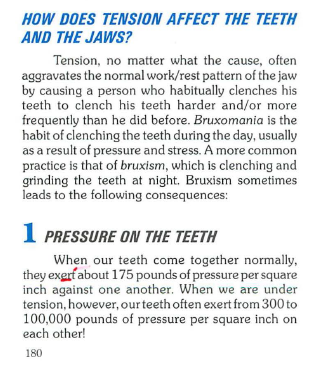
  • One concept that I worked diligently on when teaching high school was training students to be able to use common sense when looking at numbers.   Let's assume for a minute that 175 pounds per square inch is right.  
    • Does it seem logical that a person who is stressed could double (2x) the amount of force they apply to their teeth when stressed?  IMHO, that seems reasonable for a maximum force on teeth although it may do damage over time.
    • Does it seem logical that the force of a person who is stressed could increase by over five hundred times (500x)?  No, that sounds insane.
  • Based on a desultory search of internet resources, I've found a maximum bite force of ~260  pounds per tooth in humans.  The estimated bite force of a T. rex is 12,800 pounds per square inch.  That means the top range of the human bite force listed by ATI is over seven times (7x) stronger than a T. rex which is completely implausible.


  • Good news!  Science has rejected the link between malocclusion and bruxism.  Lots of people have malocclusions.  Some people have bruxism.  But malocclusions do not cause bruxism or vice versa.


  • This ATI booklet is the only place I can find that proffers the "people grind their teeth into pieces to reduce the pain of grinding their teeth into pieces argument."  Bruxism can damage teeth  but that's not the same as a cycle of grinding due to damage.
  • Man, I was about to give the booklet kudos for a decent list of symptoms until I hit the statement that bruxism can prevent people from opening their mouth.  Bruxism can reduce the amount a person can comfortably open their mouth, but it doesn't cause lockjaw.

  • Again, the link between bruxism and TMJ isn't very strong.  Some people with bruxism will have TMJ, but most people with TMJ don't have bruxism and most people with bruxism don't have TMJ.  
  • TMJ is pretty easily treated.  Many people, myself included, recover pretty quickly with OTC NSAIDS and rest.  If that doesn't work, there are lots of options like physical therapy or biofeedback that work.  If you've done a ton of damage, surgery is a n option.


  • That's not caused by bruxism.  It's usually a random occurrence with an unknown cause.  


  • I can't find anything about tooth strangulation.  The closes thing I found is when the root is reabsorbed after a traumatic injury.  
    • My husband had that happen to one of his teeth after surgery to remove his extra teeth.  (He had a partial third set that developed above his adult teeth.)  


  • Yes, bruxism is often related to stress, tension or anxiety - but not always.  Likewise, most people have times of stress, tension and anxiety in life, but only a small percentage have bruxism severe enough to require treatment.
    • No one besides the author of this booklet links bruxism to bitterness, unforgiveness, temporal values(?), immorality and/or unyielded rights.  That's just silly.


  • WTF?  
    • Basic training includes dental work.  A frequent side effect of dental work is sore jaws and teeth.  
    •  At the exact same time, basic training effectively trains soldiers to follow the orders of their drill sergeant.
    • Because of this, dental pain and the number of people following orders does roughly line-up but it's correlation not causation.   
  • Want to have some fun?  Send a message to all of your family and friends in the Armed Services with a copy of the section above. They will enjoy it. :-P


\
  • The last paragraph has to win some awards for overwrought writing.  Untreated bruxism is not going to ruin your life nearly as quickly as following Gothard's teachings.

    Remember, just say no to Wisdom Booklets!  Your sanity will thank you.


Monday, May 16, 2016

ATI Wisdom Booklet 5: Science - How Wheat Grows

In today's little slice of crazy from ATI's Wisdom Booklet 5, we take John 12:24 and use it as the basis for an entire lesson on how plants grow from seeds.  Teaching kids how plants grow is a great idea!  Using John 12:24 as a literal explanation of how wheat grows is a terrible idea.

I don't want anyone to think I'm bashing the Bible.  I love the metaphor in this verse about how death or loss often brings new life.  I've been humming the hymn "Unless A Grain of Wheat" all day.  Historically, the metaphor makes sense.  In areas of the world with seasonal dry spells - either hot times without rain or cold times where water is frozen - it seems like seeds have to go through a "dead" spell where they are dried out before they can germinate.

The problem comes is that the seeds that germinate are not dead during the dry time.  They are dormant.  This would have been impossible to see during the time of the Bible, but we are well aware of it now.

Sunday, May 15, 2016

It's Not That Complicated: The Boys - Part 5

The Botkin Sisters have brought us another selection of bizarre quotes from guys they know.  We've got some special mini-sermons to tap today!

Overarching Themes:
We have very definite ideas of how women should comport themselves.  REALLY detailed.
From "Robert, entrepreneur"
"Men wish to be inspired, encouraged, and edified through their conversations with women.  A good man will judge a woman by her conversations, and will even judge her on articulation and vocal control.  A well-mannered woman should be able and eager to carry on conversations about meaningful topics.  They should also be able to speak clearly, articulate their thoughts intelligently, and compile data in logical sequence.  This internal order can only be created by being extremely well-read.  Being well-read and having a well-ordered mind will also help temper a super aggressive, self-absorbed woman." (pg. 166)

Friday, May 13, 2016

It's Not That Complicated: The Boys - Part Four

I'm going to try a different format for the boys this time.  Since the quotes are arranged thematically, I'm going to present them this way instead of by author.

Chapter Eight has the fewest quotes of the whole book.  There are exactly two quotes about how girl's relationship with her father makes her a potential romantic partner.

According to "Rex, reformer"
"In my observation, the young women who have the most balanced perspective on guy relationships, and who maintain good deportment before men, are women who are at peace with who their father is; they are also relaxed, confident, and content with who they are as a daughter in his household.  Young women who get clear and biblically sound affirmation (fenced by loving guidance and discipline) don't usually flaunt themselves to gain the attention of men or shrink in fear in their presence; they are comfortable in their own skin simply doing what they're supposed to do.  They act stably and responsibly, neither striving to prove themselves "worthy" in front of men nor shrinking from their obligations as a well-adjusted women in a man's world." (pg. 139)

Wednesday, May 11, 2016

It's Not That Complicated: Chapter Nine - Part Three

Today's post covers the Botkin Sisters' views on women's intelligence.  To no one's surprise who has managed to read this far, the Botkin view of women's intelligence is determined entirely how she makes a man feel.

I find this entire section gross, FYI.

Overarching Theme: Girls don’t have to pretend they aren’t smart.   Girls only need to seem less smart than the guy they are talking to.
“So, at this point the $64,000 question is this: Do men actually dislike smart women?  We’ve asked a number of real men this question, and they’ve all delivered the same answer with great force: Of course not!  They just dislike women who think they’re smarter than everyone else.
Women who want to force others to acknowledge their cerebral superiority, or to beat people over the heads with all that they know, give truly intelligent women a bad rap.  Good men appreciate intelligence, but they also often come to dread the type of woman who defines herself by her smarts (as though it were the only important quality) and the arrogance, hardness, pushiness, and self-focus that too often go with it.” (pg. 170)

Monday, May 9, 2016

It's Not That Complicated: Chapter 9 - Part Two

In addition to questionable dialogue, this chapter feels like the Botkin Sisters were trying to expand the book from where all the topics were naturally spent to some unspecified length.

In other words, this chapter is pretty much a repeat of Chapters 6 + 7.  There is one new topic - and it pissed me off - but the Botkin Sisters view on female intelligence wasn't an actual surprise.

Overarching Themes: 
Being a good girl depends solely on how men perceive your actions.  Good girls should be available for sisterly interactions instantly and on demand.
“According to our brothers, they do appreciate it when: 
    • A girl seems comfortable and at ease.
    • A girl talks to them in the same spirit that their sisters do.
    • A girl is a good conversationalist, is well educated, and has interesting things to say. (Able to speak intelligently on subjects that will be of general interest to a mixed audience – e.g., topics other than sewing, clothes, chick flicks, fad diets, themselves, etc.)
    • A girl has a genuine interest in things of God, and an eagerness to speak of them and discuss them.” (pg. 160)

Saturday, May 7, 2016

It's Not That Complicated: Chapter 9 - Part One

I think the hardest genre of writing is satire.  Finding a workable balance between sympathy and criticism requires walking a razor edge.

Chapter Nine, which is titled "Rules of Engagement: Practical Tips on Interaction and Conversation", includes dialogue that is either poor satire or insulting as hell.

Really, the fact that I am most grateful for is that the Botkin Sisters didn't try dialogue prior to Chapter Nine.  The results are agonizing enough that I'm placing samples in this post rather than having these hanging over my head.

Overarching Theme: Freaking awful conversations
On how to introduce a chapter:
“It was the worst night of Cinderella’s life.  Her big dream of going to the ball in a beautiful dress had come true, but was turning into a nightmare.  Here she was in the glittering court, looking like a million dollars, right in front of the prince himself, and she had no idea what to do.

Friday, May 6, 2016

ATI Wisdom Booklet 3: Medical - Paralyzed eyelids

Today's ATI crazy medical bit takes us on a tour of how a partially paralyzed eyelid can explain humility.  Don't worry; this will make no more sense at the end than it does now.


Monday, May 2, 2016

ATI Wisdom Booklet 3: Science - The Elements of Our Body

Let's see if we can guess the science topic of this month's Wisdom booklet from the introduction:
Place your bets now!  

Feel free to hedge your bets if needed....

Did anyone guess Chemistry?  I did not.  I had assumed it would be something about human behavior or biology.  

In my teaching classes in college, the idea of introducing a topic and keeping that topic fresh in the mind of students was hammered home.  Clearly, this lesson is missing that idea.

As always, one of the questions above is not a science question.  My answer for one of the remaining three questions was viewed as wrong according to the lesson.  

Interestingly, this little side foray into the root of the word "man" in Hebrew should be redundant.  My Bible has this root explained in a footnote.  There's also a tiny bit of irony: the first three workbooks   Wisdom Booklets have been working on teaching Greek in the language section....

Huh.  I've never heard of "life" or "alive" being defined as "the presence of the Breath of God" before.    My biggest concern is that kids are going to be freaked out when they accidently step on an insect or a plant since those are being kept alive through the Breath of God.

If the authors are going to put a price tag on the elements in the human body, they really should show their math.  
  • They include a diagram later that estimates the total weight of various elements found in a 165 pound person.  If this is supposed to be a stand-alone curriculum, some math could be inserted by having students find the weight of each element in a person of their size.  
  • They could then use the current prices of various elements through Sigma-Aldrich or another chemical supply company to determine what the chemical scrap value of their body is worth.  


  • Partial credit for 92 natural elements on Earth.  The way people find that answer is counting all the elements on the periodic table from hydrogen (1) to uranium (92) on the theory that uranium is the cut-off point for naturally occurring elements.
    • The problem is that scientists have found really small amounts of elements 93-98 in ores of uranium on Earth along with tiny amounts of technetium (43) bringing us to a total of 98 elements on Earth.
  • No credit for 18 elements in the human body.  Scientist are arguing about the usefulness certain elements like strontium, but 28 or 29 seems to be a very safe number.


  • I mentioned this before, but giving the students the completed math is a cop-out.  Have the kids do it for their own weight.  
  • The unit of mass used in science is the gram or kilogram and getting students familiarized with that unit is important.  Using grams or kilograms will also make finding the cost of the elements easier since that's the unit used by suppliers.
  • Some elements missing from the list that surprised me:
    • Selenium
    • Lithium
    • Molybdenum
    • Cobalt


  • I have a major pet peeve about mixing units that can't be compared.  This section has an egregious example in using gallons of water and pounds of remaining elements.  A gallon of water weighs 8.34 pounds at room temperature in the US.  That means that a person who is made of 25 pounds of solids would have  17 gallon x 8.34 pounds per gallon = 141.78 pounds of water in them.
  • Doing the calculations in metric is actually easier!   
    • One gallon = 3.79 liters so 17 gallons of water x 3.79 liters per gallon = 64.43 liters of water
    • One liter of water weighs 1 kilogram so 64.43 L of water = 64.43kg of water.
    • 2.2 pounds are in one kilogram so 25 pounds x 1kg/2.2 pounds = 11.36kg of solids
  • Interesting tidbit missed: The damage done by lack of water is so severe at the cellular level that people will have sustained fatal and irreversible damage within 3 days.  


  • I have a theological objection to the question "How can God....few elements?"  The question implies that God is constrained by laws of nature.  In the Abrahamic religions, God is clearly NOT constrained by laws of nature.
  • Using "the characteristics of carbon atoms" as an explanation of why carbon forms chains is a major cop-out.  Carbon forms long chains because carbon has an arrangement of outer electrons in the atom that allows it to form up to 4 stable bonds at once.  
  • The explanation of the body making hundreds of substances is a tad underwhelming when you realize that organic chemistry has MILLIONS of known carbon containing compounds and is discovering new chemicals daily.
  • So...hemoglobin is made (generally) of four units called hemes bonded together.  The diagram above is showing a single heme unit.  I don't know why heme is in quotes or why the caption implies that there is one heme in hemoglobin.
  • I have NO IDEA what that waste product shown at the right is.  I've run the chemical drawing through several sites to see if I could identify it and have come up empty handed.  The term "identifies" is in quotes...and that annoys me.  
    • See, the kidneys go through a two-stage process of filtration.  The first pulls all sorts of chemicals out of the blood including needed ones like sugar, proteins and water.  The second stage reabsorbs the useful portions and shunts the waste products to the bladder.
    • When the body is no longer able to identify wastes compared to useful products, a person develops severe kidney failure.  Treatment options include dialysis and a kidney transplant.  Failure to treat kidney failure leads to death.


  • First, the hormone also known as "growth hormone" is misspelled.  The correct spelling does not have an 'h'.
  • Secondly, the authors skirted a raft of issues surrounding human growth hormone (HGH).  Some, like athletes doping using HGH, probably arose after publication.   Others, like the fact that HGH for human use hinges on using recombinant DNA placed in bacteria to make HGH, should have been on the editors' radar if this was published after 1980.
  •  Third, some elements are much more important than others in terms of human medicine.  Some of the trace elements in the body are hard for people to get enough of while others have no known deficiencies. Case in point: most adult women will be tested for iron deficiency at least once during their reproductive years while no one will ever be tested for a copper deficiency 


  • Look, death is the cessation of biological processes.  While most religions agree with the statement that the spirit - or whatever term is used for the supernatural portion of a human - leaves the body around the time of death, not all do.  Equally importantly, the spirit isn't part of scientific studies.
  • The quack definition of death wreaks havoc in the rest of the paragraph.  If the spirit is needed for correct immune function, does that mean people with AIDS and leukemia are missing their souls?  How about the biological havoc that ensues in a brain-dead patient?
  • I don't want to do the research needed to figure out if their order of bodily decomposition is right, but I do see at least one problem.  The brain is highly guarded against bacteria.  A bacterial infection of the brain is a massive medical emergency.  How, then, does the brain manage to decompose first if the only decomposition agent is bacteria?
    • The real answer is more complicated, but refers back to something covered previously.  Life exists because life continually adds energy into the body to prevent the second law of thermodynamics - overly simplified means: Everything falls apart over time - from being in effect.  When someone dies, the second law of thermodynamics comes raging back into effect.  Even in the total absence of bacteria, the cells of the body will degrade (and do so quite quickly).


  • Not wrong, but very strange that the first law of thermodynamics isn't referenced here.  The kiddos were (allegedly) taught in the last booklet that evolution can't happen because energy cannot be created or destroyed, just transformed.  This would be a great place to introduce the Law of Conservation of Matter: Matter cannot be created or destroyed.   (For HS aged kiddos, you should combine the two to cover nuclear physics and get "Neither matter nor energy can be created or destroyed, only converted.")
Next up: ptosis!