Friday, March 10, 2017

Before You Meet Prince Charming: Chapter Two - Part Two

The allegory in this chapter covered why emotional purity is like a rose torn to pieces.  Moving into the self-help portion of the chapter, Ms. Mally starts teaching us about the evils of dating.

The introduction begins blaming dating, modern culture and general lack of thinking for the current trend of awful marriages.

"If you look at the fruit of the American system of dating, there is reason to be seriously concerned. The majority of modern marriages end up in divorce. Few marriages are truly happy. And many enter into marriage with injuries, emotional handicaps, and scars from past dating relationships." (pg. 34)
  • Sloppy transitions and failure to explain conclusions are two ongoing problems that CP/QF literature is ripe with.  Yes, I know that your audience is strongly inclined to view dating as evil, but that does not absolve the author from laying out a connection between behavior during dating and behavior during marriage.
  • The old "50% divorce rate" trope is trotted out again.  There are so many problems with that statement....
    • Measuring divorces as a function of marriages is a statistical nightmare.  There is no federal requirement that states collect or publish the number of marriages per year so researchers are left trying to estimate out the data based on cohorts like everyone who was married in the 1980's.
      • With that qualification, the lifetime divorce rate of people married in the 1970's and 1980's was estimated at between 45-50%.  By comparison, the divorce rates for the 1960's and the 1990's were placed between 30-35%.  The reasoning for the uptick in the 70's and 80's had more to do with society transitioning from a breadwinner-homemaker model of marriage to a marriage between loving equals.
    • I would be remiss not to point out that the highest rates of divorce in the last three decades has been among couples who marry young without college degrees while the lowest divorce rates are among people who marry later in life and have degrees.
  • I need some data - or even some compelling anecdotes - to support the claims that most marriages are miserable because the people entering marriage are emotionally devastated from dating.  Now, there are plenty of anecdotes about people who were hurt by emotional purity before marriage.
After the introduction, the chapter takes a sudden left turn into the topic of the importance of Christians marrying other Christians.  This section starts with Ms. Mally describing a time she was met a young woman at a friend's house who was getting married to a man who was not a Christian.
    • Ms. Mally glosses over the fact that the young woman doesn't seem bothered at all by the fact her fiance is not a practicing Christian. 
    •  Ms. Mally also implies the young woman is marrying someone she only met 6 months ago which is the time that the couple started dating.  That may be true, but the two may have had a previous friendship before dating.   
  • From this bland memory, Ms. Mally extrapolates that the woman she just met is making a illogical and ruinous decision because she and her intended formed an emotional relationship that would be too painful to break.  For me, this feels like a major over-reach of the information at Ms. Mally's disposal from a woman she just met.
This leads into a list of reasons...scenarios....a brainstorming session..... I don't really know what to class this as... that lead Christians to marry non-Christians.
We can make a list of possible reasons:

1. It could be that one of them lied. You know, a guy will say anything for a girl, and vice versa.

2. Perhaps one of them was sincerely deceived and considered himself to be a believer, but didn't understand the gospel -- that Christianity is a personal relationship with Jesus Christ, formed at the moment in time when one specifically and genuinely asks Christ for forgiveness and mercy.

3. Maybe they both went to the same church or were from the same denomination and therefore just assumed that the other was a Christian.

4. They might have believed that after marriage they would be able to lead their spouse to the Lord.

5. Possibly, they felt pressured into getting married by circumstances or other people.

6. Maybe one of them got saved after they were married. Well, that's a good problem! Someone came to know the Lord.

We can continue to list other possible scenarios, but actually there is just one main reason for unbalanced marriages - it's called dating." (pg. 35-36)

For my sanity, I'm going to re-write each point above in a more coherent fashion before refuting the issue in each.

Point One:  Christians marry non-Christians because the non-Christian lied about their salvation status.
Rebuttal: It is true that some people lie to potential romantic partner.  While someone could lie about their salvation status, Christianity isn't a cryptic religion; a Christian is supposed to act like a follower of Christ.  As two people get to know each other, someone who lies about their salvation status will most likely show other signs of not being that into their religion.  More importantly, a guy or girl could lie as easily in a courtship as they could during dating.

Point Two: Christians marry non-Christians because the "non-Christian" self-identifies as a Christian under different guidelines than the "Christian".
Rebuttal: This isn't a problem caused - or even exacerbated - by dating.  This is what happens when the "Christian" doesn't bother to explain their personal or church requirements for membership in Christianity to someone else.  If you want to marry a Christian self-identifies under evangelical beliefs, be clear to your romantic partners about that.

Point Three: Christians marry non-Christians because being a card-carrying member of an evangelical church isn't proof of actual Christianity.
Rebuttal: *rolls eyes* For the love of God, ask your partner if they are a Christian under whatever definition you use is.  This is not that complicated - and needs to be done in a courtship, betrothal or arraigned marriage as well as in dating.

Point Four: Christians marry non-Christians because they hope they can change a major life characteristic of their spouse after marriage.
Rebuttal: People change over time, but expecting major changes in someone after marriage is unfair to the "changee" spouse.  After all, Sarah Mally et al. would be up in arms if atheists were marrying Christians as a step in getting the Christians to deconvert.   Like the three previous points, this isn't a problem with dating; it's a problem of marrying under false pretenses.

Point Five: Christians marry non-Christians because the Christian feels pressured to get married because of circumstances or other people.
Rebuttal: Funny, after reading the first four points, I think Christians marry "non-Christians" or non-Christians because of a release of pressure.  Spending your life in a pressure cooker where everyone is trying to determine who is "saved" sounds horrible.  Imagine meeting someone who believes your statement of being a Christian at face-value.  No need to compare theological definitions or need to prove that you asked Christ for forgiveness and mercy. Now, THAT would be a delicious release of pressure.
On a more practical note, if you expect to have the fortitude, stamina and conviction to spread the Gospel to the ends of the Earth, you cannot seriously expect me to believe that a good saved Christian will crumple under something as minor as societal pressure for marriage or an unplanned pregnancy.
This, yet again, has nothing to do with dating.

Point Six: Christians are married to non-Christians because the Christian converted after marriage.
Rebuttal: How is dating even remotely related to this?  It's not.

This post is already long so I'm going to break this into two posts.  The next post really drives home the dangers of writing a book on dating when you've never dated or spent any time around peers who dated.

Tuesday, March 7, 2017

Before You Meet Prince Charming: Chapter Two - Part 1


This chapter pertains to the evils of dating. Because of that, I assumed that the allegory would show the dangers of dating.

Silly me.

Synopsis of Allegory:

  • The narrator informs us that the Princess spent a bunch of time at home meeting various dignitaries and servants.  She learned a lot of unspecified things from them and did her job of making life pleasant.  
  • She thinks about what the Alligator told her and wonders if she should socialize more with the People.  
  • The Princess asks the King if she can go to the Spring Fair.  
    • The King explains that since virtue is really important, the Princess should be a light for the People by not doing anything that compromises her vision of purity.  (The first quote below happens here.) 
    • The King and Princess have a fruitless discussion where each is pursing a different goal. 
    • This leads into a disturbing example of how easily emotional purity can be lost.  (A section of this section is the second quote.)  
    • The scene ends with the King telling her to protect her heart until it is the right, undisclosed time somewhere in the future.

This first quote demonstrates the problems that occur in many CP parent-teen relationships.
"But what about the spring fair?" she persisted. "All the other maidens will be there, and they have asked me to join them."
" All the others? Surely, thou dost not seek their approval?"
"No, Father," she said slowly. "but if I never experience the real world, I fear that I will never fit in.'"
"Fit in?" he said in surprise."Who said anything about fitting in? Of course, thou wilt not fit in. Does thou wish to be like the other maidens and youth?"
" Oh no! They are silly and chase after vain things," she answered. " But father, what thinkest thou of the alligator's words? Do you not think that I should socialize?"
" It depends on the purpose," he answered.
" The alligator says I will never meet a prince if I do not learn to mingle more freely as do others," the princess sighed. "he says that the other maidens socialize oft with the young men in the village."
" But you say you do not wish to be like the other maidens. And besides, such is not befitting a princess. My daughter, thy role is not to fit into the world -- but to change it.(...)" (pg. 31)
  • Problem One: The King uses questionable communication techniques to railroad the Princess to the answer he wants.
    • The King uses his questions to his daughter to express horror that the Princess would even think about wanting to be outside of the CP Emo-Pure boundary.
      • This subtly reminds her of what is expected of her while pre-emptively shutting down any discussion of her wants or needs in terms of socialization.
    • At the same time, his questions also play on a normal teenage fear of "being abnormal" by telling the Princess that she's really, really abnormal - you know, in a good way - but so very abnormal.
      • This is a twisted way of reinforcing the Princess' sense of isolation for the purpose of making her too afraid to go to the Fair.
  • Problem Two: The Princess wanders through a bunch of side tangents rather than asking the question that is bothering her the most.  
    • The Princess' problem is completely normal in teenagers and often improves as teenagers become young adults.  Communication is a learned skill. .
    • Imagine if the Princess started with "Dad, I'm worried that if I don't meet more people I will never get married.  I want to be with other appropriate girls as friends to learn the social skills I will need when it is time for me to court."  That would be concise, honest and reasonably open her father about her feelings, needs and wants.  
    • Why didn't she start with that?  It's one part normal teenager and 99 parts growing up with parents who place image and ideals above emotions and growth.
  • Problem Three: The King refuses to put his foot down.
    • I have a deep dislike of parents requiring their toddlers, kids or teens to be lead to the "right" idea - in this case, stay home from the Fair - and expecting their offspring to be alright with the parent's pre-made decision.  
    • It's really nice when parents and their underage children are on the same page - but it's not a requirement.  I believe parents have an obligation to communicate why they are enforcing a rule in an age-appropriate manner.  Offspring have an obligation to listen to their parents. Parents need to enforce the rule and accept that their toddlers, kids or teens may be angry, mad, or sad and help the kid deal with that emotion.
    • Imagine if the King had started by saying, "I hear that you want to make new friends, but the Spring Fair is not a good/safe place to do so because _______.  How about you start going to the Princesses' Ball where you will meet other members of royal families?"  
  • I've reviewed three CP books for young women.  All three have rampant examples of disturbing, pathological styles of communication in families.  That's a stunning indictment of what is required to keep people in this worldview.
Next we have a creepy, twisted, sick metaphor about emotional purity that brings all the skeevy "A girl who has had sex is like a used inanimate object" metaphors racing back.
"Look at this. What do you see?" her father questioned.
" A lovely rose," she said.
" What color?"
" White."
" Pure white," her father emphasized. " What else do you notice?"
" Well, it is closed. It is just a bud."
" What is the inside like?" He inquired. " Open it for me."
"I can't open it for you!"
" Why not?" he asked.
" Because it has to open by itself," she stated.
" But I want to see the inside," repeated the king.
"then you will have to wait for it to open when it is ready. If I force it open, you will never see its beauty."
"But are you not overly cautious?" teased the king. " We'll only open a few petals."
"The rose is very delicate," she answered. " The petals will tear, and it will never be the same."
" And so it is with many fair maidens," the king explain. " Their beauty is never fully seen, for they wait not until the proper time. They are handled and played with by too many a fellow. Their heart is opened prematurely. The fragrance and beauty that was intended for the perfect time is lost or damaged forever." (pg. 33)
  • I have been soaked by bovine amniotic fluid while wearing a dress, fallen face-down into manure and rolled down a dusty ravine landing a patch of poison ivy. 
    • None of those experiences were as disgusting as the previous "rose metaphor".  Not even close.
  • There is no part of the human body or mind that is a single-use organ.  None.  And you know what?  Neither is a rose.
    • I swear that CP writers have never seen an actual rose bush.  Look at the picture below - there is more than one damn flower on that bush! The Princess could have ripped the rose to shreds and the bush would still have had plenty of other flowers on it. 
      •  People don't have a single heart that they hand off to their spouse and no one else - we have lots of hearts that we give to many other people in our lives.
    • The next thing the CP writers need to do is look at an actual rose bud.  Interesting fact: You can rip a whole lot of the outer petals off and have a lovely flower. 

      • Pick off the outer group - the remaining petals will open farther.
      • Hell - that's the easiest way to make a group of fading roses look fresh again; pick off the petals that are discolored and voila!  Fresh bouquet!
        • Humans are the same.  A dating relationship that failed doesn't mark you indelibly forever; rather, over time the painful parts are shed and the resulting person is stronger.
    • Declaring that the rose - which isn't opened - is "pure white" is stupid. What color do you think these roses appeared as buds?  Completely freaking white!
There are several buds on the right side....
      • The important characteristic of a marriage is long-term compatibility. Hiding your heart before marriage cannot assure mutual love, friendship, mature communication skills and patience after marriage.  Anyone who tells you otherwise is either clueless and/or trying to sell you something.  Like this book, for instance.
  • I can't decide which is more disturbing:
    • Option One: Ms. Mally doesn't see a problem the blatantly sexual portion about being "handled and played with" in a conversation between a man and his daughter.  (So gross....)
    • Option Two: Ms. Mally was too sheltered at 25 or 26 not to realize the massive innuendo of that sentence - and no one around her felt compelled to explain it to her.
  • How the hell does this fit in with the whole "Purity is offered to anyone!" of the last chapter?  The point of this allegory is "Don't give your heart away too early or you will be completely worthless."
Well, I need a shower.  Next up, Sarah Mally's views on the evils of dating based on her deep personal knowledge base.

Friday, March 3, 2017

Before You Meet Prince Charming: Chapter One - Part Two

 In the first part of this chapter, we learned that the Princess is young and very sheltered by her father, the King.  Her biggest problem right now is the Alligator who brought up the fact that she's doesn't have the skill set to help her people and that she'll have to make choices some day.

Next, Ms. Mally launches into an overview of "radiant purity".  As near as I can tell, it encompasses all the annoyances and headaches of maintaining physical purity with a whole new level of crazy when it comes to avoiding emotional entanglements.  Perhaps that's the secret point - if you are so closely guarded that you've never shared an indiscreet smile with a boy, you don't have to worry about losing your virginity.

Let's look at some choice quotes:

The difference was not ultimately a result of how they met, how they got to know each other, or whether they called their relationship "dating," "courtship," "betrothal," or anything else.(pg 22)

Monday, February 27, 2017

Before You Meet Prince Charming : Chapter One - Part One

"Before You Meet Prince Charming" by Sarah Mally has a few interesting points in its favor.

  • Sarah Mally has reached the level of writing competence found among high school graduates!  She understands and uses the conventions of the English language fluently; After "Preparing to Be A Helpmeet" and "It's (Not) That Complicated", I am grateful to read a book without feeling a compulsion to pull out a red pen and fix the mistakes.
  • Ms. Mally starts each chapter of the book with an allegorical tale involving a teen-age princess living in a kingdom.  Writing this was more complicated than the common "exhortation and advice" style of religious self-help books that I've previously reviewed.
The allegory has five main characters introduced in the first chapters:
  • The Princess is the archetype of Christian Patriarchy unmarried daughters who want to do "what is right" in the words of the author which means "follow the rules of CP without questioning if possible".
  • The King is the archetype of the Christian Patriarchy father.  His wisdom is deep and unfailing; his goal with his daughter is to keep her completely unaware of the emotional entanglements and "vices" of the world.
  • The Queen is the archetype of the Christian Patriarchy mother.  She is present in a few vignettes, but seems to have given all of the duties of instructing her daughter over to her husband.
  • The Villagers  or the People stand for everyone outside of Christian Patriarchy.  None of them understand why the Princess is kept as sheltered as she is.  Most of them want the Princess to "experience life".  Their main purpose is to serve as a counter-point of how horrible life is for people who "experience life".  Their secondary purpose is to be enlightened by the sheltered Princess' life.
  • The Alligator is the urge every CP unmarried daughter has to break free and experience life.  This is why the Alligator is the main antagonist of the book.
Synopsis of the "Desiring the Very Best Marriage" allegory:
  • The Princess rides home from visiting her aunt and uncle some distance away.  
  • As she rides home, an elderly couple and their grandson see her.  The grandparents explain that she's a princess both by birth and by conduct.  
  • The unseen, omniscient narrator lets us know that the Princess is still young because she sometimes forgets to obey her parents, occasionally questions their ways and finds people who disagree with her parents rationale understandable.  
  • During this ride, the Princess wonders why her father is concerned about the People's behaviors and opinions as well as what her future holds. 
  • She's met by a sentinel sent by her father in case she was delayed.   The two chat and part ways.  
  • The narrator returns to let us know that she's riding unaccompanied because the King wants her to serve people - but that the King protects her from unspecified dangerous activities that were seen as harmless by the People.  The narrator returns to the theme that the Princess can't possibly appreciate all her parents do for her because of her youth - even when she obeys them without question.  Likewise, the Princess has hopes and dreams about doing good works - but she really, really would like to meet the right Prince for her and get married.  She's 16.  
  • As the Princess stops to stare into space and daydream think of all the major works she's going to accomplish, the Alligator swims up in the moat.  The Alligator tells her that she's unduly sheltered and lacks the skills she needs to fulfill her unspecified dreams.  The Princess responds each time by saying that the King knows what's best for her.  The Alligator tells her to be ready to make her own choices when it becomes necessary. 
Response to the allegory:
  • When writing fiction, a good author shows the reader instead of telling the reader.  In this section, every piece of information about the royal family is explicitly told.  Even the feelings of the People towards the Princess is expressed through a canned conversation between the elderly Grandparents and their Grandson.
  • I'm already finding the Princess's world stilted.  
    • She's royalty - but her father wants her to help her people - but she's not supposed to pick up any of the People's unspecified bad habits.  
    • I will admit, however, that this is an excellent allegory for Christian Patriarchy families.  The family is better than the average person due to their rigorous lifestyle  and should be helping the world around them without accidentally contaminating their lifestyle with any of the worldly views of the people they are helping. 
  • Children may not have the moral or cognitive depth to explain their beliefs to outsiders, but a 16-year-old girl needs stronger rhetoric  than a slightly more polished version of "Dad said it's wrong and I shouldn't do it."  
  • The sum total of good works done by the Princess in this first section is "picking up vegetables that an old woman dropped".  That is NOT a ringing endorsement of the King's plan to have her serve her people.  
  • The Alligator makes two good points.  
    • First, what skills does the Princess have that can help her people?  Based on what I've read, she can pick up veggies and ride a horse.  Even with that limited skill set, she's not done anything particularly note-worthy like bringing food to the elderly or ill.  
    • Second, the Princess will have to make decisions on her own some day.  Neither her parents nor her future husband will be available every second of every day for the rest of her life.  It's not possible for either of those two authority sources to list out in great detail what to do in every situation that could occur.
    • If you need further proof of the Princess' helplessness, she can't even break of the conversation with the Alligator; the beginning of the the storm does that.
The next post will look at the "exhortation and advice" section of the chapter.  Methinks I will not enjoy that more.....

Friday, February 24, 2017

Before You Meet Prince Charming: The Beginning

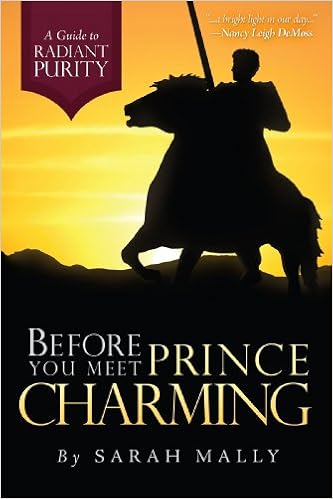
We have a new first!  This book inspired me to write the first blog post on the cover, the cover quotes and the author's note.

The Cover
The cover is a bit terrifying, honestly.  There is a back-lit guy on a horse holding a lance...or a mace...perhaps a broadsword.  My husband wanted to know if Prince Charming was a euphemism for the Angel of Death in Christian Patriarchy after seeing the cover.  Judge for yourself:

Has he come to marry you or steal your soul? (added snark from Mel :-P )

Monday, February 20, 2017

It's Not That Complicated: Wrap-up

I've spent more time thinking quietly in the last three months than I have in years.   Truthfully, I didn't think about the Botkin Sisters or CP/QF until late last week.  Taking an unplanned break has brought a painful truth home:

By following the rules of Christian Patriarchy, the Botkin Sisters have missed life.  

Life means seeing people as fellow humans made in the image and likeness of God:
  • My husband and I were waiting for an elevator at my son's hospital when a Mennonite couple exited a down elevator.  We waved at their robustly healthy son who looked to be about 2.  The mom saw my bag of breast milk (which means I'm headed to the NICU) and said quietly to me, "Our son and his twin sister who is upstairs (e,g. is in the hospital) were born very early here, too.  I promise it will get better soon."  I teared up and thanked her.  I replied, "My twin sister and I were born very early.  I got better right away but it took my sister longer.  She was in and out of the hospital when we were toddlers - but now she's wonderfully healthy.  It will get better for you, too."
  • My son's biggest cheerleader is a Somali cleaning woman who gives us an update of how well he was doing when she was cleaning his area.  Understandably, the election of Trump terrified her especially when he closed the borders to Somalis.  I hope that my explanations of her rights as a permanent resident of the United States and how the Judicial Branch can block the Executive Branch from acting against the Constitution gives her as much comfort as she gives me every time she tells me my son is a "big, big, healthy, boy!"
  • Has the Botkin Sisters book prepared any of their readers for interacting with all people as befits an understanding of people created in the image and likeness of God?  No, this book has given explicit examples of treating people who fail to conform to upper-middle class standards of respectability in the US as fallen scum.
Life means giving pieces of your heart away:
  • I am grateful for my husband's ex-girlfriend in Ireland.  He clearly loved her and she loved him - but he couldn't move to Ireland and she couldn't leave her younger siblings at least one of who would be too young to remember her well.  Under Emo-Pure (emotional purity) rules, I should hate her and be anguished at the loss of a chunk of my husband's heart.  Instead, I am grateful for the time they had together, happy that my husband and I have created a life together and hopeful that she's formed the wonderful family she deserves.
  • Emo-Pure implies - and occasionally states - that reserving your heart for your husband will keep you safe from heartbreak.  In truth, all things this side of heaven will end. 
    •  I saw the terror in my husband's eyes as he realized our son might die due to a severe premature birth.  He didn't tell me until months later that he was terrified because he realized that I might die during the c-section if the doctors couldn't control the bleeding because my platelets were so low.  
    • I started sobbing just before being taken for the c-section because because the doctors were going to have to do medical procedures on my son that would cause him pain to keep him alive - placing IVs, placing an ventilator tube - and there was nothing any of us could do because the other option was both he and I dying.
  • This book has failed to prepare their readers for the messy, painful realities of being a loving human and offers instead a sterile, crushing form of self-protection that will crush and destroy the hearts of the people who practice it.
Life means working with the talents God gave you:
  • The OB and NICU units of our local hospital - which is a regional center - are staffed mostly by women.  My OB is a woman. Of the team of 8 medical staff who ran my C-section, only the anesthesiologist was a man.  The neonatologist who lead the team who stabilized my son is a woman as were the NICU staff members who helped her.  All of the neonatal nurse practitioners are women.  There are over 200 RNs in the NICU; less than 10 are men.  
    • Now, according to the Botkin Sisters, these are women who traded off marriage and a family for a career.  The doctors underwent 8 years of post-secondary education and a three year residency; the nurse practitioners did 6-7 years of post-secondary education with at least one year of nursing full-time in between college and their graduate degree.  The nurses have a four-year nursing degree.  Clearly, that's completely incompatible with being a wife and mother.
    • Alas, no one remembered to tell the women this - the majority of the women are married and have children.  
  • There are plenty of options for people who don't want to do a full 4 year degree.  A two-year degree leads to a LPN, a physical therapy assistant or a respiratory therapist.    Shorter training programs exist for phlebotomists and surgery technicians.
  • Heck, there are tons of options for people who don't want any post-secondary training.  The Botkin family is emblematic of Christian Patriarchy's disdain for people who work as employees rather than owners of their own business.  Yet, a cashier who who is pleasant, cheerful and capable can make his or her many customers in a day feel a bit better about life.  
    • There is one particular cashier at the cafe at my son's hospital that I'm thinking of right now.  She's fast and very, very pleasant.  Our interactions are short - but the relief I've gotten from knowing that I can pay for my lunch without any complications or delays while also seeing a smiling face has been a ray of hope and comfort during times where both seemed to have disappeared behind clouds.  (I only wish that more people had told her how much her work means to parents at the hospital.)
  • This book fails miserably at showing readers how to live as a follower of Christ.  There is no emphasis on feeding the hungry, clothing the naked, visiting the imprisoned or any of the corporal and spiritual works of mercy.  Instead, a self-important and self-centered form of Christianity where personal and family image is idolized to the detriment of God is celebrated.

    I'm glad to be done with this book.  Sharing my home with the glassy, brittle images of the Botkin Sisters was unpleasant.  Next on my reading list is "Before You Meet Prince Charming" by Sarah Mally.  

    Side note: Is writing a book about living as a CP unmarried daughter the kiss of death for getting married?  Sarah Mally is older than I am by a few years and unmarried.  I'm starting to see a theme.....

Thursday, February 16, 2017

It's Not That Complicated: Chapter 12-Part Three

Oh, Botkin Sisters. I haven't missed you at all. But we do have to finish this book before I ceremonially burn my copy, so here we go.

Most CP/QF female bloggers stick to a healthy dose of slut-shaming to justify picking on the looks of other women.   For Anna Sofia and Elizabeth, however, that's too one-dimensional.

Join me as we venture into their shallow and petty logic.

"We were still in our hooded sweatshirt and baggy-jeans days when we first discovered this facet of biblical femininity, and it was (as you can imagine) revolutionary to us. We were clothing ourselves to communicate what we wanted to be (invisible, and totally above thinking about clothes). We didn't realize that a woman's appearance, countenance, speech, and attitude don't just communicate who she is - it says something to the world about who her husband or father is. Whether intentionally or not, we don't just communicate our identity - we communicate theirs too." (pg. 220)

Sunday, February 12, 2017

Update from the Disappearing Blogger :-)


Enjoying finally looking pregnant during the first week of November
Looking at my old post dates, I'm having a hard time believing that I haven't posted since early November which seems like yesterday....but a lifetime ago, too.

I guess I should just jump in.  Figuring out where to start is the hard part, though.

On November 18, 2017, my husband's family had a small party for Thanksgiving.  I had a blast.  Since the food at holiday parties is richer than I'm used to and I was 25 weeks pregnant, I was annoyed, but not surprised that I started having gas pains after the meal.  That night was miserable, but I adjusted my diet, got more exercise, and took some pregnancy safe anti-gas medications.  I was still much more gassy than usual, but that's pregnancy for you.


On November 23, 2017, I was working on a blog post when I smelled rust.  While I was trying to figure out what the hell was going on, blood started gushing out of my nose.  I ran to the bathroom, grabbed a ton of toilet paper and applied tons of pressure.  The bleeding stopped within a few minutes.  Honestly, it took longer to clean up the blood on my face, hands, shirt and the drips I lost control of when rushing through the house than it did to stop the bleeding.    I told my mom about the bleeding - it reminded me of the one time I broke my nose - and she asked if I had had elevated blood pressure at all during the pregnancy.   I hadn't had any elevated blood pressure.  In fact, my blood pressure had been 110/70 at my last OB check up about 10 days before.

Thanksgiving came!  My mom and brother were going to meet my husband and I for dinner at a local Chinese restaurant.  Nico had to work on the farm so it was just Mom, Mike and I for dinner.  The restaurant was closed so we went to IHOP.  I haven't been there in years and was thrilled to have Red Velvet Pancakes.  My stomach was acting up a bit from time to time, but a heavy starch sounded amazing.  My super-kind mom left a huge tip for the waitress since the restaurant was slow.  The waitress was touched and we all chatted for a bit.  I made some kind of joke about the fact it was completely dark at 6pm at night; did I mention winters in Michigan suck?

That night, my stomach was still gassy, but around midnight I started having sharp pains by my belly button.  The pain was keeping me from sleeping.  I wondered if I was having Braxton-Hicks contractions, but it didn't feel like my entire uterus was tightening, just the uppermost part.  I spent an hour trying various remedies that my OB had sent home with me - walk, rest, drink water- and realized around 2am that I was still awake, miserable, and - oh, yeah - the pains seem to have a rhythm to them.   I dug out the emergency number for my OB's practice and called.  One of her partners strongly recommended that I go to the hospital to get checked out since premature labor needs rapid treatment.

I went to the hospital.  I wasn't having contractions - just some disordered Braxton-Hicks.

The nurses took my blood pressure.  It was 206/115.  I had developed severe pre-ecclampsia in 10 days.  

I was attached to an IV, had blood drawn, the works.  The nurses had a hard time getting my blood pressure to drop;  turns out I inherited paternal family's ability to ignore beta-blockers.   Eventually, my blood pressure went down to "higher than ideal, but not dangerous" and I was sent up to L and D for a few hours of monitoring and then they would send me home.

That was the plan, anyways.  There was one piece of information missing: my blood work hadn't come back.  When it did, everything changed.

The blood work showed that my liver enzymes were extremely high while my platelets were dangerously low.  Not only did I have severe pre-ecclampsia, but I had developed an extremely rare syndrome that can occur with pre-ecclampsia known as HELLP.   My liver was becoming extremely overactive.  This causes it to start digesting itself while destroying red blood cells and platelets.

I knew what HELLP was.  HELLP kills women when left untreated from seizures, strokes and uncontrolled bleeding from liver ruptures.  HELLP kills babies by having the placenta detach before birth and leads to torrential bleeding.


I had walked into the hospital critically ill. If I hadn't gone to the hospital, Jack and I would have been dead in hours to days.

There is one cure for help: immediate delivery of the baby.  The problem was that I was 26 weeks, 1 day pregnant.

The doctors and nurses worked a miracle.  They were able to stabilize me long enough that I received two doses of betamethasone to speed my son's lung, skin and intestine development.  I delivered Jack by emergency CS 28 hours after I got the first dose of betamethasone.  That's 32 hours after I called my doctor or 40 hours after we left IHOP.
Jack's baptism at 4 days old. He weighs 1 pound. 5oz.

Jack weighed 1 pound 12 oz and was a whopping 12 inches long.  The neonatologist held Jack next to me for a few minutes so that I could give him a kiss and tell him how much I loved him, how glad I was that he was safe and that he was totally worth all of the pain of the last 28 hours.

I can't really describe the last 11 weeks.  Maybe someday, but not now.

Jack's done well.  His lungs were still very, very underdeveloped.  He spent a month on a ventilator followed by two weeks on NIPPV and three weeks on CPAP.

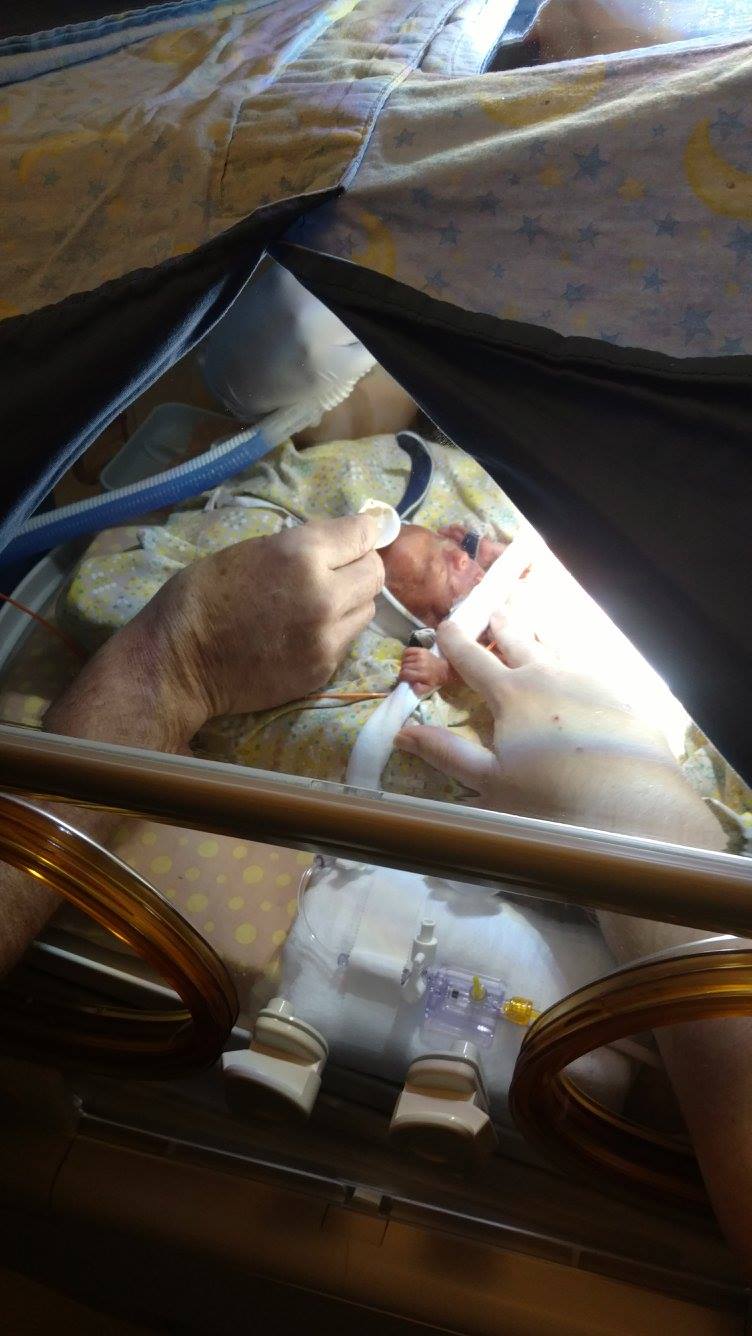
The pictures are easier to focus on and I do like showing off my handsome son.
Holding Jack for the first time.  He's a week old and weighed about 1.5 pounds. That was the day after I went home from the hospital.
The smaller the baby, the more people needed for basic care.  Notice the arm waving free in spite of my husband and my best efforts.......

"Feisty" is good; Having a 2 pound baby who tries to lift his head and pull his ventilator tube out....not so good.  Hence the hand I have clamped on

Doing "containment" to help Jack feel secure.  He always likes having hands on his feet because he could kick at them.
Jack's around 3 weeks old or 29 weeks gestation in the picture.  He's on a ventilator still.  


Jack's first Christmas as Santa's newest elf.

Jack dressed as a vampire in honor of his fourth blood transfusion.


Jack's sharing some bonding time with my husband.


Jack's on NIPPV or CPAP in this pic.  He started regulating his body temp at a very young age so he'd overheat during skin-to-skin if we put a real blanket on him.  Hence the bandanna.
The most "Jackian" photo we have so far!  Dude does not like having his arms contained and will break free of any swaddle known to man...


Actually, this might be the most "Jackian".  Notice the hand shoved free of the swaddle and a leg held at a 45 degree angle.  When your kid is attached to monitors, you can use a weighted beanbag to make him feel safe....and keep his pacifier in place.

You really do get used to all the tubes and cords attached to your kid.  When I look at this picture, what I remember isn't the medical things but starting to cry when I came in Jack's nursery because Jack was in a real crib.
We dressed him for the first time at 35 weeks gestation (or 9 weeks after he was born).  It took me 20 minutes mainly because I'd never done a kimono style onesie before
When Jack was switched to a nasal cannula for oxygen, I felt like we had a changeling baby; I had gotten so used to the hat and mask for the NIPPV and CPAP that seeing his whole face and head was startling and wonderful.
Reading a book aloud on sustainability for my Master's.  The neonatologists were always telling us how good it was that we read to Jack; I've never had the heart to tell them that I read aloud because staring at a monitor while Jack was asleep was very, very boring.
Being able to pick up and hold my son without needing medical backup has been amazing!  Holding him when he was on a ventilator required at least 1 respiratory therapist and two nurses to safely transfer him to and from the isolette.  When he switched to NIPPV/CPAP, we only needed one nurse.  Now, I can pick him up whenever we want to or whenever he needs some cuddles.
Jack's Mafia enforcer face  :-)
"No, really, Dad.  The nurses said I can stay up all night.  Don't you believe me?"  I think we'll be seeing that face a lot :-P


Jack's sleeping in his dinosaur position in his dino jammies!

Sunday, November 6, 2016

It's Not That Complicated: Chapter 12-Part 2

I love this section!  There are two themes running through the middle of this chapter.

 Theme one: A pair of highly sheltered very young women have determine what ALL men need in a wife. This theme is a hoot because any person who has been in a satisfying long-term relationship can shoot massive holes in this theme (and believe me, you will be seeing me take aim.)

Theme two: Anna Sofia and Elizabeth Botkin are the most eligible women ever since they have all of the skills a man needs! This theme is rather depressing because it shows that neither of the Botkin Sisters - or their "editors" - can recognize a massive personal bias.


For every girl we know asking why so few young men are "ready," we know a young man asking where the ready and eligible girls are. Our brothers and their friends have told us that many of the qualities girls have cultivated to make themselves "eligible" are things that won't come up on young men's radar screens, and the qualities that young men are most looking for have been neglected. [...]
The first step in understanding how we can become "helper suitable" is to understand what exactly a man is supposed to be doing that he would need help with. A man who is taking Dominion (Genesis 1: 28), discipling the nations (Matthew 28: 19), and feeding Christ's sheep (John 21: 15 - 17) is going to require more of his wife then the ability to iron a shirt, cook a meal, and look good on his arm. We may not be able to predict whether our husbands will have a use for stenography skills over musical proficiency or business acumen, but what every good man we'll need from his wife (no matter what he does) will be a willingness to get her hands dirty, be stretched, learn new things, work hard, and die to herself. (pg. 215)
  • Ninety percent of my graduate program is learning how to read technical papers and how to check for mistakes in the procedure.  
    • Tip One: Make sure that the reference group or sample group is representative of the population as a whole.
      • The reference group for this "case study" is the Botkin Bros - two of which would have been teenagers when this book was written - and the friends of said brothers.
        • Implications: The reference group is highly sheltered and members of the same closed system of beliefs.  At the same time, many of the members have been raised by the same people and are more similar in beliefs than an average random sample from a closed system.
      • Outcome: This "case study" may be of value if you are a) a Botkin Brother, or  b) a friend of the Botkin Brothers, but is of limited value for the rest of humanity.
  • I don't mean to be wry, but being a good cook IS a way of feeding Christ's sheep.  See most ministries involving homeless people.  
  • I'll be willing to bet that business acumen - as indicated by the ability to hold a job, grow a career, or build a business - will be much more in demand than either stenography skills or musical proficiency in the absence of business skills.
  • In the real world, relatively few available men are in business for themselves.  Most people work for other people.  As such, most men (and most women) don't need specific skills from their spouse to grow their career.  My husband gave me a few new ideas for labs to do with my students and a listening ear when I needed to blow off steam.  That's honestly about as much as most spouses do directly for the other spouse's career.
Godly men need women who have intrepidity, courage, and sturdy virtue to come alongside of them in the rigors of  their lives. They also need wives who have a good grasp of such things as current affairs, worldview, and politics, and who care about the things their husbands are interested in and involved in. They need helpers who recognized that loving their men means loving the mission and the work their men are called to do (pg. 215-216).
  • OMG!  All men totes need the three things that the Botkin Family likes to pretend they are good at - current affairs, "worldview" and politics!   You should totes marry us!
  • Any bets on how much the Botkin Sisters understand about:
    • Educating politicians about the benefits and drawbacks of using Generally Accepted Agricultural Management Practices (GAAMP) as guidelines for nuisance suits involving farms?  
    • The potential benefits and problems with implementation of Common Core standards with the legal testing requirements in Michigan? 
    • Common issues with the standardized testing options available for determining how well secondary and post-secondary students understand the nature of science?
    • And yet, I know single men who work in each of these areas - and really don't want to hear about "worldview" or - God forbid - Geoffrey Botkin's thoughts on Brexit.
  • The best irony - the Botkin Sisters know women who were poorly prepared for what their husband actually needed from them in terms of career skills!  To be fair, this example was published after the book, but the Botkin Sisters have never retracted their views on this point.  I've linked the blog post about Genevieve (Smith) de Deugd's experiences of her first four months of marriage.  I've also pulled some choice sections: 

"We knew that working together on projects and in Pete’s sawmilling/woodworking business would add another dimension to our relationship, strengthen our marriage, grow our friendship and be a whole lot of fun!"
  • I'll give the de Deugds' credit: working in a spouse's business can either be great for a marriage or destroy a marriage in short time.  
    • For our marriage, we've decided it's healthiest for me to stay outside of the farm in terms of a career.  Family businesses can bring a lot of family baggage and I'm a better resource for my husband as a person outside of the system.  
 "Being a daughter in my father’s home and helping him was predominantly an intellectual and sedentary lifestyle. Being a wife in my husband’s home and helping him involves a lot of manual work and is a very active lifestyle. I’ve had a lot to learn."
  • I am intrigued by the fact that Genevieve thinks her dad's ministry that promotes homeschooling was more intellectual than doing sawmilling and woodworking.  I'm guessing that that dichotomy is mainly due to the fact that she's still learning about running a sawmill and woodworking.  The more advanced woodworking and sawmilling skills require some pretty solid mathematics skills.  
  • Is having Genevieve learn how to do some really basic work on the machinery really the best use of her talents?  Presumably, she learned a bit about marketing and website design in her work with her dad.  Rather than have her duplicate what her husband is doing, wouldn't the family have been better served by having her work to increase business?  (Or - gasp- bring in independent income through a job/career of her own?)
  • When I was first dating my husband, I thought that I would be learning how to milk cows and do other basic labor around the farm.  When we got more serious, my husband was very clear that he wanted to marry a wife who would be a partner in his life - not a substitute milker.  Plus, I could bring in more income and benefits by having an outside career.  When I moved out to the farm, I realized that my main benefit to the farm was understanding more about human resource management to give my husband support as the amount of time he spent managing workers increased.   I've still never milked a cow or driven a tractor; it's just not a good use of my time or skills.
  • I hope that she learned that wearing skirts around a shop and in junkyards is not a safe idea.  I've given up wearing shorts on the farm when I'm working in the shop or up in the haymow because my legs get cut up but good.  
Back to the Botkin Sisters....

A girl recently asked us what is the number one thing that most girls fail to learn in order to be ready for marriage. For years, we've been advocates for girls amassing a rigorous education, vast inter-disciplinary knowledge, boatloads of practical skills, and the like. But since watching two of our brothers choose their companions for life, we've had a slight shift in our understanding of what men really need. "The capacity for deep relationships," we replied. A wife and mother's job will call out many different strengths and abilities and each of us, we explained her, but the most important of all will be our ability to develop real relationships. If we get married, the biggest impact of our lives will come from our relationships with our husbands and our relationships with our children. If we never marry, the biggest contributions of our lives should still be our fruit for relationships with those around us (pg. 218).
  • Again, the Botkin Sisters begin with a vision of wifehood in which the wife is mainly a tool.  Actually, they never move off of the idea that women are supposed to be handy tools for men.  Their view of marriage isn't two people joined and growing within a marriage and raising up kids to be healthy adults; instead, women are a tool to develop relationships between people.
  • I do appreciate the Botkin Sisters' understanding that our main legacy is from our relationships with others; that's a worldview I can support.  I am disappointed, however, that the Sisters can't make the next connection that our relationships outside of our families can be as vital, as fulfilling and as live-changing as being a daughter, sister, wife and/or mother.
There is one post left in this series!  One post.  Wow.  There is an entire chapter on contentment, but there's no meat to it so I'm not going to waste time going over it.  I've got my next book picked out - a short one for a break from the Botkin Sisters for a month or two.   Last post: The Botkin sisters make a list of things that they are allowed to judge people on.  Plenty of fat-shaming, too.  May as well go out on a "high" point.

Tuesday, November 1, 2016

It's Not That Complicated: Chapter 12 - Part One

Chapter 12 is titled "What a Man Needs at His Side: How to Become a Girl a Man Would Want as a Wife as Well as a Friend.  Ironically, I can start by parsing the problems with the title of the chapter.
  • The first word of the chapter title is an interesting Freudian slip.  The Botkin Sisters use "What" - a term used to designate an object in English - instead of "Who".  A man apparently doesn't need a woman; he needs a tool.
  • Girls shouldn't marry.  Girls are by definition immature and still growing.  A man who is looking for a wife is looking for a woman or a lady.  (If a man is looking to marry a girl, he's not going to be a good husband.)
  • A healthy friendship is the cornerstone of a marriage.  CP/QF bloggers and talking heads get all wound up about sex and raising children - and forget the basics.  The tools used to keep a long-term friendship going are the same tools that are used in a marriage.

We knew from the beginning that this could not be a book about how to get married, as neither of us have had any personal experience doing that. However, in writing about how to be the kind of woman that the men around us need us to be, we knew that we couldn't ignore the elephant in the room: girls want to know what young men need in the one woman that is going to stand by them for the rest of their lives. What do they need in their best friend? What do they need their helpmeet? (pg.209)